
Banana Squash: How To Cook It
This post may contain affiliate links. We may earn a commission if you purchase via our links. See the disclosure page for more info.

Today, it’s all about how to cook banana squash, and it’s so easy! My friend, Debbie, gifted me this beautiful squash. It’s about 16 -18 inches long.
She asked me if I wanted it, and of course, I said, Yes! I mentioned to her that Mark is not fond of squash, but I am. Mark’s mother loved to cook and serve baked squash to her family frequently. She had a similar approach to preparation to the one I’m writing about today, by roasting or baking the squash. I’ve grown to love squash and have made wide varieties part of my garden planting plans for years.
I told Debbie I would write a post about it and bring some cut squash for her family to enjoy. Mark and I delivered a few pieces of it, baked and ready to eat. Ever since I received this one from Debbie, I’ve been looking for additional squash from our local farmer’s market.
In case you missed this post, How To Dehydrate Zucchini-Sliced & Cubed
Kitchen Items You May Need:
- Baking Sheet or Cookie Sheet
- A Good Knife
- Cutting Board
- Aluminum Foil
Banana Squash: How To Cook It
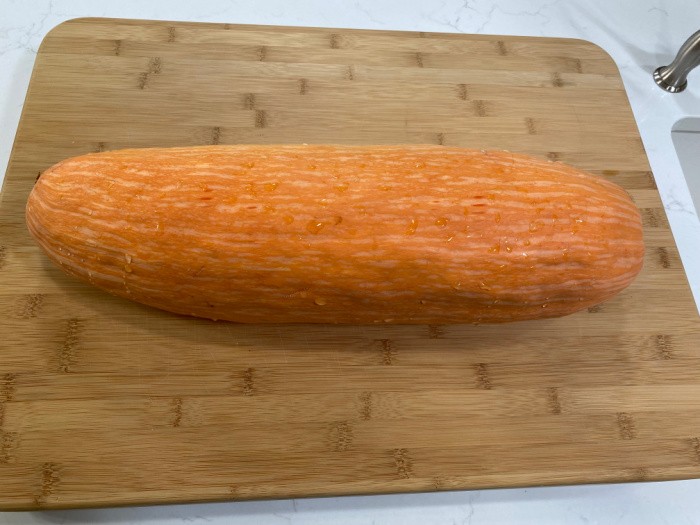
Step One: Preheat the Oven and Wash the Squash
Preheat the oven to 375°F/190°C. First, wash and scrub the squash and look for any bad spots to cut off. This one was in perfect shape and ready to slice. You certainly don’t want a squash of poor quality, and I’m grateful for the beautiful one we enjoyed this week!
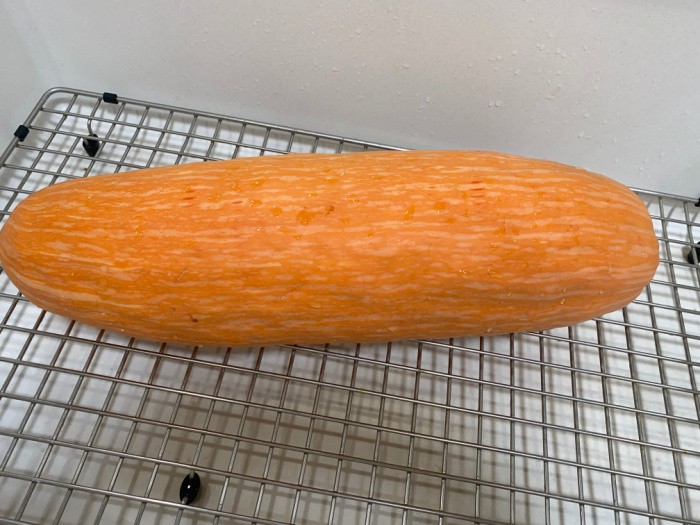
Step Two: Cut the Ends Off and Slice it Into Sections
Cut the ends off and slice the banana squash into 3-inch sections using a sharp knife.
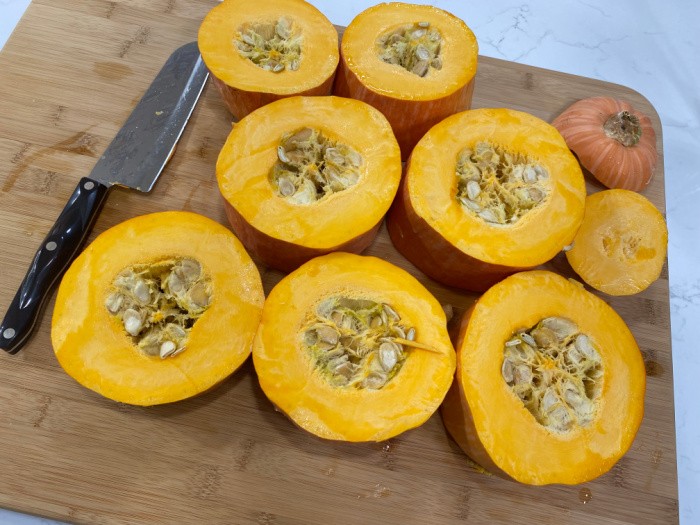
Step Three: Slice and Cut In Half
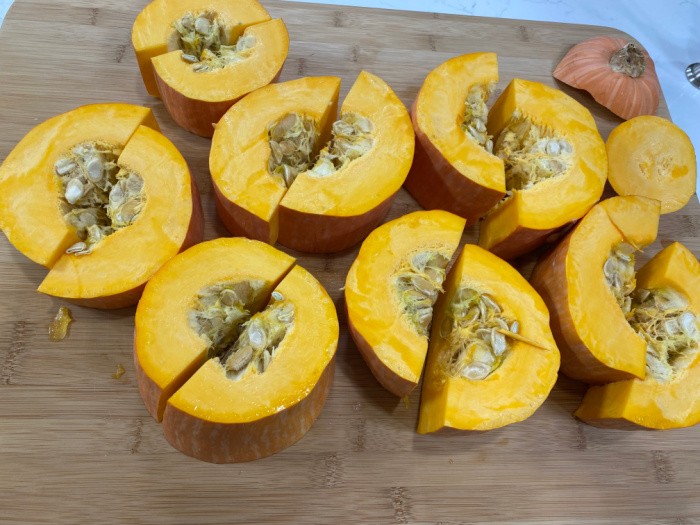
Cutting it this way is much easier because you don’t have to handle such a large squash. I used an excellent knife, which was easier than I had expected to cut through the rind and flesh. Now, you cut those pieces in half.
Step Four: Scrape The Seeds Out
Now scrape the seeds out with a tablespoon or similar tool. Remove the excess stringy “meat” of the squash, leaving the delicious orange flesh to be cooked. The flesh is similar in color to the apricots we all love. I’ve suggested that my readers consider saving the seeds of squash and other vegetables for planting later, especially if they’re from heirloom varieties.
Step Five: Remove the Outer Skins or Rind
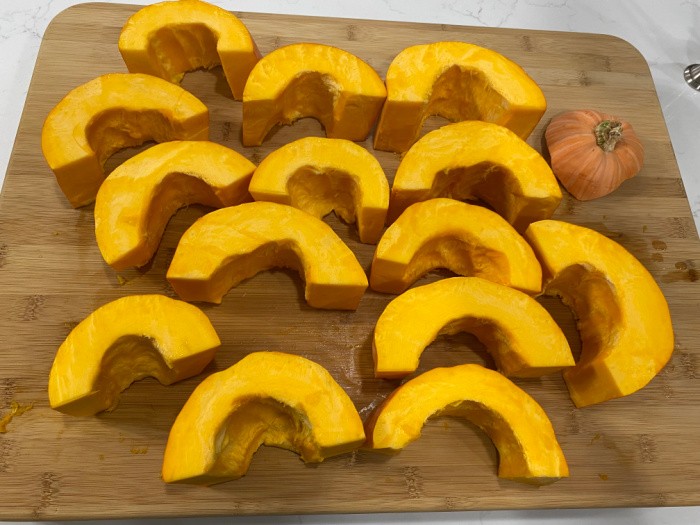
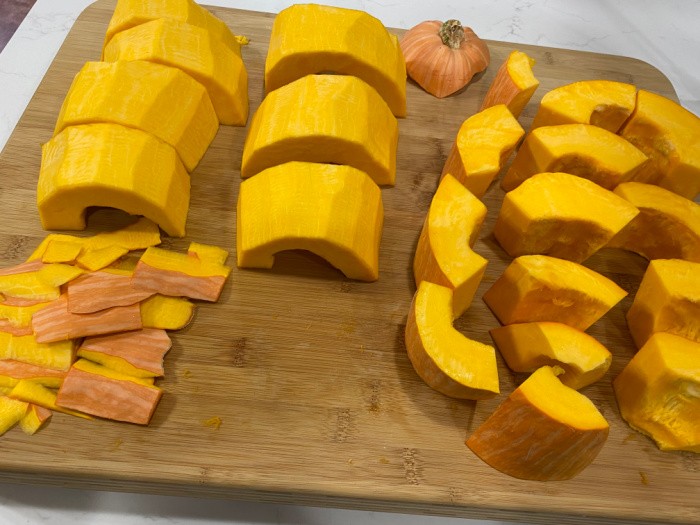
Now, cut the pieces again, and remove the skin on the ones you’ll cook on another day. We left the skin on the pieces we’re baking today.
Step Six: Refrigerate With The Outer Skin Intact
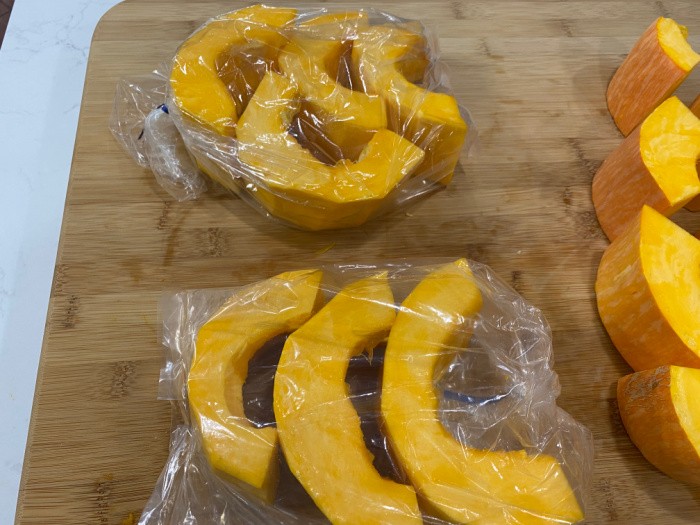
As mentioned, remove the skin from the squash you plan to cook later. Place the peeled pieces in a bag or container and refrigerate for up to five days. Some people like making these slices even smaller, so they’re small cubes, particularly if they plan to use them in soups, stews, or even as a pizza topping.
Step Seven: Scratch The Centers with a Fork
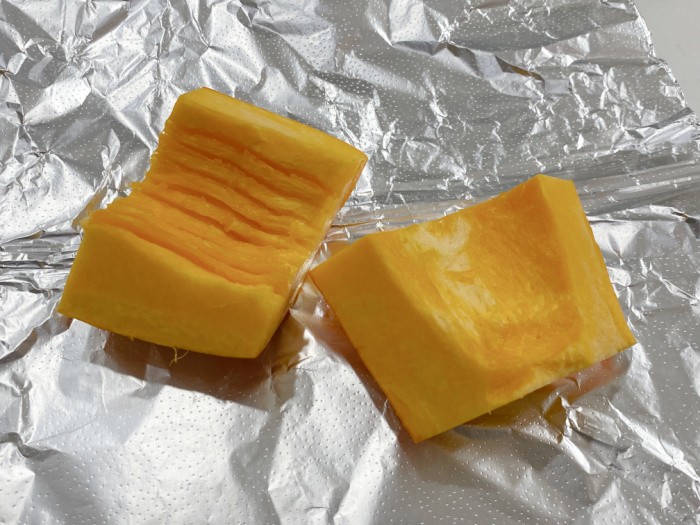
Use a fork to lightly “scratch” or “score” the banana squash meat, allowing you to add butter, cinnamon, brown sugar, another sweetener, or your choice of herbs, such as honey or rosemary.
Step Eight: Add Butter and Spices
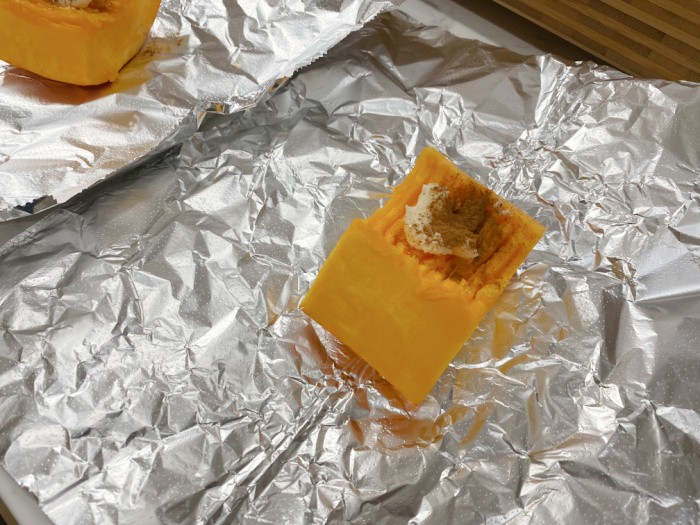
Place a dab of butter in the middle of the squash pieces to be baked, then sprinkle with the desired amount of cinnamon on each piece of squash. Add the brown sugar or other sweeteners now or after you bake it. You may want to salt and pepper it as well. You may consider going light on the sweeteners so it remains more of a low-calorie entree.
Step Nine: Wrap in Foil and Bake
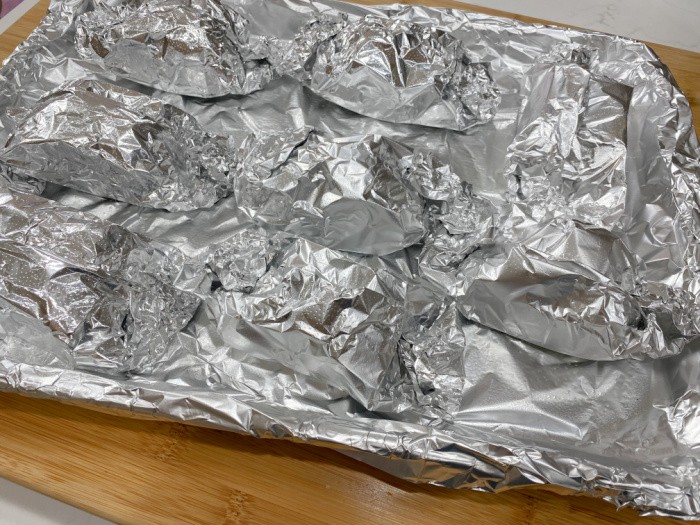
Now, wrap the separate pieces of banana squash tightly in aluminum foil. Place a piece of aluminum foil on your cookie sheet and spray it with vegetable oil.
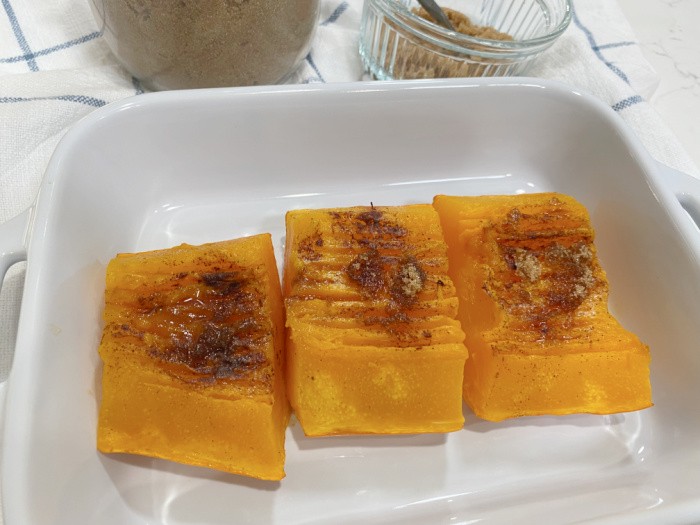
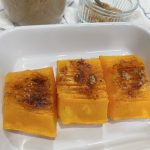
Place the wrapped squash pieces on the covered cookie sheet. Bake for one hour and fifteen minutes or until baked through. I use a fork to check for tenderness so they’re ready to serve.
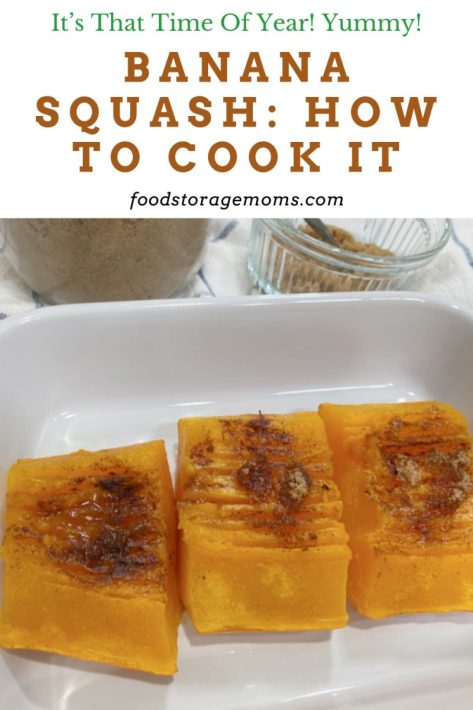
Finished Product
Banana Squash: How To Cook It
- 1 Banana Squash
- Butter
- Brown Sugar
- Cinnamon
-
Preheat the oven to 375°F/190°C.
-
First, wash and scrub the squash, then look for any bad spots to cut off.
-
Now, cut the ends off, and slice the banana squash into 3-inch sections. It's much easier to cut it this way because you don't have to handle such a large squash.
-
I used a heavy-duty knife, and it was easier than I had expected to cut through the skin and flesh.
-
Now you cut the pieces in half.
-
Now scrape the seeds out with a tablespoon or similar tool. Remove the excess stringy meat.
-
Now, cut the pieces again, and remove the skin from the pieces you plan to cook another day. We left the skin on the ones we are baking today.
-
Again, remove the skin from the squash you won't be baking the day you cut it.
-
Place the peeled pieces in a bag or container and refrigerate for up to five days.
-
Use a fork to lightly "scratch" the banana squash meat, allowing you to add butter, cinnamon, and brown sugar (or your preferred sweetener).
-
Place a dab of butter, with the desired amount of cinnamon, on each piece of squash.
-
Add the brown sugar now or after you bake it. You may want to salt and pepper it as well.
-
Now, wrap the separate pieces of banana squash in aluminum foil tightly.
-
Place a piece of aluminum foil on your cookie sheet and spray with vegetable oil. Place the squash on the cookie sheet.
-
Bake for one hour and 15 minutes, or until baked through. Use a fork to see if it's tender.
Why Banana Squash Is Easy to Grow
Banana squash is a forgiving choice for gardeners of every skill level, which is part of why so many self-reliant families keep it in their gardens year after year. It belongs to the Cucurbita maxima family, the same group that gives us Hubbard, Buttercup, and Kabocha squash, and like its cousins, it tends to shrug off many of the pests and diseases that trouble more finicky vegetables. The vines are vigorous growers that can stretch anywhere from twelve to twenty feet, so while it does need generous space, it rewards that space with a heavy harvest from just one or two plants.
Because banana squash is a warm season crop, it should go in the ground after the last spring frost once the soil has warmed to around seventy degrees. Seeds typically germinate within one to two weeks. From there, the plant mostly takes care of itself as long as it gets full sun, well-drained soil enriched with compost, and a deep watering once a week rather than frequent shallow sprinkles. Watering at the base of the plant instead of overhead helps prevent powdery mildew, which is the most common disease banana squash faces, and it’s easy to manage by giving the vines room to breathe.
Families who want to encourage children to help in the garden often find banana squash especially satisfying to grow, since the fruit gets so dramatically large that kids love checking on its progress week to week. It typically takes 100 to 120 days to reach full maturity, so it’s usually planted in late spring for a fall harvest, making it a natural fit for anyone building out a homestead-style growing calendar.
Why Banana Squash Is So Nutritious
Banana squash earns its place on the table as much for its nutrition as for its size. One cup of cooked banana squash provides a substantial dose of vitamin A, primarily from beta-carotene, which supports eye health and a strong immune system. It also provides a meaningful amount of vitamin C, potassium, and dietary fiber, along with smaller amounts of magnesium, calcium, and B vitamins such as B6.
The fiber content makes banana squash a helpful food for digestive health and for maintaining steady blood sugar, since fiber slows the absorption of natural sugars. Its potassium supports healthy muscle function and helps balance sodium in the diet, which is especially useful for families watching their heart health. And because banana squash is naturally low in calories and completely free of fat, cholesterol, and sodium, it’s an easy way to add nutrients to a meal without adding much else.
For families focused on food storage and self-reliance, banana squash offers another advantage. Its dense flesh and thick rind allow it to store for weeks or even months in a cool, dry place, which means a single squash purchased or grown in the fall can provide nutritious meals well into winter without any canning or freezing required.
The History Behind Banana Squash
Banana squash traces its roots to South America, with evidence of its Cucurbita maxima ancestors found at ancient sites in Peru. Long before it reached North American gardens, wild squash of this type grew across parts of South and Central America, where indigenous farmers gradually selected and cultivated the varieties that produced the sweetest, most pleasant-tasting flesh.
The squash made its way into the United States in 1893, when seed company R H Shumway introduced it through his catalog. It quickly became popular with home gardeners in the early twentieth century, valued for its size, its long storage life, and its rich, sweet flavor. Around the turn of the century, another seed company selected different color variations from the original plants, which is how we ended up with the blue, yellow, and pink-skinned varieties that are still grown today.
Interestingly, one well-known relative of banana squash, the Georgia Candy Roaster, has its own rich story rooted in the Cherokee people of North Carolina, who grew it as early as the 1800s. Squash in general holds a place of honor in American agricultural history as one of the Three Sisters, grown alongside corn and beans by Native American farmers for generations before European settlers arrived. Though banana squash fell out of mainstream popularity as smaller, more convenient squash varieties like acorn squash gained favor, it has enjoyed a resurgence among heirloom gardeners and homesteading families who appreciate its old-fashioned character and generous yield.
Ways to Serve and Bake Banana Squash
Banana squash has a mild, naturally sweet flavor and a dense, meaty texture that makes it wonderfully versatile in the kitchen. Here are several ways your family can enjoy it.
Roasted banana squash cubes. Peel the squash, cut it into cubes, toss with olive oil, salt, and a little cinnamon or nutmeg, and roast at four hundred degrees until tender and lightly caramelized at the edges.
Baked banana squash halves or rounds. Slice the squash into rounds or halves, remove the seeds, brush with butter or olive oil, and bake until soft. A drizzle of honey or maple syrup makes it a comforting side dish for a family dinner.
Banana squash soup. Simmer roasted or steamed squash with broth, onion, garlic, and a touch of cream for a warm, filling soup that’s perfect for cool weather. A sprinkle of nutmeg or ginger adds a lovely finishing touch.
Mashed banana squash. Steam or boil the squash until soft, then mash it just like a potato, with butter, salt, and pepper. It makes a wonderful side dish for holiday meals or Sunday dinner.
Banana squash pie. Because its flesh is so similar in texture to pumpkin, banana squash makes an excellent substitute in pie recipes, offering a slightly sweeter, richer flavor that pairs beautifully with the traditional warm spices.
Squash in soups, chilis, and stews. Cubed banana squash holds up well when simmered, so it’s a natural addition to hearty chili or vegetable stew, adding both nutrition and a subtle sweetness.
Thin roasted slices as a pizza topping or salad addition. Thin slices roasted until tender can be layered onto a pizza or tossed into a fall salad with greens, nuts, and a light vinaigrette. What is banana squash?
It is a large winter squash in the same botanical family as gourds and pumpkins. This variety of squash can grow to be quite large, reaching two or three feet in length and weighing close to 35 pounds.
Although they’re considered a “winter” squash variety, they’re generally available year-round but are more prevalent in the fall and winter.
Are banana squash and butternut squash the same?
Although they’re similar, the two are different varieties. Banana squash has a nice mellow flavor, and it can be used in any recipe calling for a squash-colored orange, like the acorn and kabocha you often see in the store or at your farmer’s market.
Can you eat the skin of a banana squash?
The skin is thick compared to many squash varieties and is thrown away since the meaty flesh is the only edible part of the squash.
How can I store the freshly picked squash until I’m ready to cook it?
Store the picked squash in a cool, dark, and dry place at 50-60°F/10-15°C in a well-ventilated area with good air circulation.
How do I store the raw, uncooked banana squash?
Place the raw squash with the skin removed in a bag or an airtight container in the refrigerator. It will be suitable for 3 to 5 days.
How do I store the leftover cooked banana squash?
Place the cooked banana squash in an airtight container and store it in the refrigerator for 3-4 days.
Can I freeze the cooked or raw banana squash?
I wouldn’t recommend freezing the raw or cooked squash. It’ll become too mushy and watery. I’ve read where it can be frozen, mainly if you take the time to puree the squash first. You can try freezing it and see what the results are, rather than having any go to waste.
Can I microwave the leftovers?
Yes, you can. The banana squash tastes even better the next day after being heated in the microwave.
What can I serve with the cooked banana squash?
- Pasta
- Chicken
- Turkey
- Steak
- Pork
- Salad
- Spicy Sausage
- Add it to a pot of soup
- Top it with leftover stuffing/dressing
- Eat it as a meal
Can I use a different sweetener?
Yes, you can use white granulated sugar, Stevia, honey, or any other sweetener your family likes.
Do I have to use a sweetener?
No, you don’t have to use a sweetener. I prefer one, but it’s because I have a sweet tooth. Some people like the squash’s “natural” flavor. Try it both ways and see which approach you like best.
Is putting a dab of butter necessary?
No, it’s not necessary, but it makes it taste delicious!
Can I use a different spice?
You may want to try just salt and pepper or another of your favorite spices. Don’t be shy about trying other spices you typically use on your favorite veggie offerings. I like to use nutmeg, cumin, and even thyme sometimes.
Are there any health benefits to eating squash?
Winter squash varieties are good sources of beta-carotene, vitamins B6 and C. You can count on getting a fair amount of fiber, potassium, and magnesium too. Another good quality of eating squash is that it’s considered low-calorie.
Final Word
Banana squash may not be the most common vegetable on the grocery store shelf, but it deserves a place in every self-reliant garden and kitchen. It’s easy to grow, it stores well through the winter months without any special equipment, and it brings a generous amount of nutrition to the table at a time when so many families are looking for simple, wholesome ways to feed the people they love. Whether you roast it, bake it, mash it, or tuck it into a pot of soup, this humble squash has a long history of nourishing families, and it can do the same for yours. I hope you’ll give it a try this season and discover just how much comfort and value can come from one large, unassuming vegetable.
There’s something about growing our food. I’m so grateful that my friend Debbie gifted me this banana squash. This is the first time I’ve ever cut or baked one. I hope you found my post about banana squash helpful as you look for quality veggies to eat during the year’s cold months. It’s all about practice, practice, practice. If we can teach our kids and grandkids how to cook from scratch, we’ll live in a better world! If you like squash and cook it often, let me know your favorite approach to make it a special part of your meals; we love to hear from our readers. May God bless this world, Linda



This is how we do our acorn squash too
Hi Matt, I need to try Acorn squash, I see at the Farmers Markets. Linda
You will love it Linda. Bake as you do the Banana Squash, or stuff with your favorite stuffing and bake. 350° until fork tender. Leave the skin on. Or slice into rings, peel and bake. Fresh acorn lasts for weeks at room temperature. Much longer in root cellar conditions. I suggest Apple Pie Spice or Pumpkin Pie spice mixtures and ginger as other seasoning ideas. Curry goes with Butternut and would also work here. Take care, you’re experiencing terrible heat waves, severe drought, and wildfires out there, and now Covid 19 Delta Variant is spreading rapidly, too. I hope you and your’s stay safe and healthy. MA❤️❤️.
Hi MaryAnn, oh my gosh, this sounds delicious! I will try it for sure. Yes, we had that terrible dust storm that killed I think 8 people on the main highway going north. I believe it was a 22 car pileup. CRAZY weather! The heat is going down a bit now, thank goodness. We have a lot of people in Utah against all V. No judgment, here, but the cases are rising so quickly and people are dying. It’s crazy, young, middle age, and the elderly, it’s so random. Utah has the highest number of UN-V. I have a daughter with MS, I’m not the only one that knows someone with a compromised immune system. God help us. Stay safe, stay healthy, Linda
I know, Linda. You know I’m just outside of Boston now, and the mega cluster on the Cape in Provincetown. I only got the J&J Vaccine, there are no indications of it’s effectiveness against the Delta Variant. 70+% of the cases on the Cape are breakthrough cases. Some are hospitalized. I have lung and heart damage, if I get a breakthrough case, I’m really worried that it would be another really bad case. So I’m back in full isolation here. My husband is working, but his hospital is not taking Covid patients at this time, it’s a private Psychiatric Hospital, so they can do that. He got the Moderna shots, and he’s being really careful to not to bring it home to me. It’s really scary. This variant doesn’t respect immunization. So far no one has died, but I’m really concerned that will change. Delta could spawn an even worse variant. If it does, this fall and winter could make 2020-2021 pale in comparison. The high breakthrough rate is only going to give the anti vaxxers more reason, not to take the vaccines. I have 3 cousins with MS and there are so many people who are immune compromised, elderly who haven’t been reached yet, children with no authorized vaccine yet. So many vulnerable people who don’t deserve another wave. God help us, and protect us from the selfish.
Hi MaryAnn, I was so glad that Utah lifted the mask rule but it may come back. I went to the store yesterday and Costco was packed. I never go on a Saturday but I needed some bacon. I told my husband if we aren’t sick now we may be after we leave here. After last year we are in tune with people coughing and sneezing around us. AND it could be just allergies! But no one knows, really! God help us all, literally, we need it. Linda
Ditto
Hi Ray, thanks for the 5 stars! I love squash! Linda
I have never heard of banana squash. Yellow squash, acorn squash, zucchini, and spaghetti squash is all I can think of. I love the spaghetti squash. Wash cut, clean out seeds. Put butter and seasonings and bake in the microwave til done. Use a fork to get the spaghetti noodles out. (It looks like them.) it is so good. My MIL made it with Tony Catcheries seasoning.
Deborah, there must be at least one hundred different types of squash. The banana squash I’m most familiar with is called Candy Roaster. Google it. You’ll like it if you like squash. I’ve tried at least a dozen different Native American squash varieties, (my favorite being Hopi Pale Grey) but by and large I stick with zucchini, patty pan or yellow straightneck Summer squashes and Acorn or Delicata for winter squash. I know Delicata is technically a summer squash but it lasts so well I can keep it like a winter squash. The Hopi Pale Grey is a fantastically good squash that keeps for at least 6 months in my pantry without losing flavor. The only problem with it is it will take over one of my 4′ x 16′ raised beds and try to escape. As an experiment I’m cooking one tomorrow that I harvested last October–9 months in storage and it’s still firm.
HI Ray, I love hearing this. It was in cold storage and is still firm! Linda
My mom loved banana squash and baked it, as well. I hated it!! It was too sweet and the strings made me gag. As an adult and wanted to get a replacement for pumpkin, I used squash. I pureed it and now have many recipes to use it in. My kids loved the pancakes, breads, etc. and never complained. There is always a way to use winter squash without baking them . Also, once purees, it can be dried to add to soups , stews and to make pies with. There are always ways to get veggies into families that they will love!!
Hi Cheryl, my husband hates banana squash! He never complains about any meal. I eat the banana or butternut squash and I LOVER it!! LOL! I will have to puree some and add it to pancakes, that sounds awesome! Linda
Serve the pancakes with warm applesauce or maple syrup. It also makes wonderful dinner rolls.!
Hi Cheryl, oh yeah, that would be delicious!!! Linda
My husband and daughter and daughter in love like squash. I wonder if you can fry this type of squash? My husband does not like baked squash and refuses to eat it. So can you fry this squash? It looks like the skin is thin and it can be cut up in small pieces.
If anyone has any ideas about frying this type of squash let me know. He used to only eat yellow squash but we get Mexican and Zucchini squash and it is cheaper to mix them instead of just getting the yellow because I know the Mexican is cheaper than Yellow where we live. I also wonder if I can find it around where we live.
Hi Jackie, I could have cut it into squares and fried it. Just take it and try it. Fry it in a little butter??? I have to find it at Farmers Markets. Linda
Thanks for letting me know. I will look at sprouts and a couple other organic places and see if they have it. I have never heard of it before now. I wish I knew where to get seeds for it and I would grow it in buckets.
Love
Jackie
Hi Jackie, I love Butternut squash too, it has orange flesh. You may want to try that one, most stores sell it. Linda
I tried a long time ago to use Butternut squash and Jack didn’t like it. He’s really picky and that was his mother’s doing. If she didn’t like it she would tell her kids it wasn’t worth eating. I have changed his eating in some ways but there are others he refuses to budge on. Oh well G-D gave him to me and I love him to death
Love
Jackie
Hi Jackie, best comment ever! Some things aren’t worth the battle! LOL! I’m lucky as well! I love Mark to death and he will eat just about 99.99% of whatever I fix EXCEPT squash! LOL! Life is so good, Love you, Linda
If you get one, instead of throwing the seeds away, save them. It’s simple to do. I just did with the Acorn squash I just cooked. I washed the seeds as best I could removing as much pulp as I could. Then I put them on a paper towel, on a paper plate, put them in a dark place to dry. Once seeds are dry, put them in an envelope ( with name on it and date ) then put the envelope in with your seed stash until planting time. Happy Growing!
Hi Pam, oh my gosh, I should have done that! I was so excited to be gifted the banana squash I forgot to save the seeds!! Thank you for the reminder!!!! Linda
I use a cleaver and a rubber mallet to tap the blade through winter squash. I find it safer than trying to cut them with a knife, no matter how sharp.
Thanks for the introduction to banana squash.
Hi Lori Y, thank you for the 5 stars, my sweet friend!!! Oh, I have got to try your method, thank you!!! I need to order a meat cleaver!! I have the rubber mallet! Great tip! Linda
Linda. LOL, you’re welcome!
I love banana squash and used to eat it all the time. Now I never see it anymore. We live in Tennessee and I grew lots of butternut squash but I prefer banana to them. I don’t ever even see the seeds to buy anymore.
Hi Becky, wow, I need to see if I can get some seeds here. Thank you for the 5 stars, my sweet friend! I will keep you posted, Linda
I’ve always wanted to learn how to cook it. I made it last night and it was so delicious. Thank you so much.
HI Alli, thank you for the 5 stars, my sweet friend! I’m glad you enjoyed the recipe! Linda
My family loves this recipe! It is so delicious! Thank you so much for sharing!
Hi Camille, thank you for the 5 stars, my sweet friend. I’m so glad you liked the recipe! Linda
This was so good! Thanks for the recipe! I’m always looking for new things to make!
Hi Heidi, thank you for the 5 stars, my sweet friend! I”m glad you enjoyed the recipe! Linda
Tom is not a squash fan, but since it is your recipe he is willing to try
Hi Chris, thank you for the 5 stars, my sweet friend. Mark does not like any squash, including this one. I gave back half the squash to my friend, ready to cook. I could eat the whole thing, but it was way too much. I love it! LOL! Linda
This is a new squash to us! Don’t believe we’ve seen in KY. Have you had zephyr squash? Our fav summer squash. Our garden seems to have an over abundance. Cross between zucchini and pattypan. Holds its firmness better; not as watery. Fav recipe so easy: Cut small cubes and vadalia onions, sauted in butter just until hot with salt, pepper and fresh garlic. I freeze it grated to throw in chili, spaghetti meat sauce, and wherever I can sneak in it
Hi Marilynne, thanks for the 5 stars, my sweet friend. I love squash, any kind; what you do sounds delicious! Linda
Linda, it wasn’t in cold storage unless you call inside temps between 75 and 80 degrees cold storage. It was simply kept at room temperature and out of daylight.
If someone has a large in-ground garden, Hopi Pale Grey would be the best squash to grow because it stores long enough to get you through to the next year’s harvest. As an added bonus it tastes great.
Hi Ray, thank you for telling me about the Pale Grey squash. My neighbor keeps hers in a cooler basement; I’m not sure what the temperature is. I don’t have anywhere to store winter squash long-term. I love squash. Linda
The only thing I do different when I’m cooking squash is I peel it before de-seeding it and chopping it up.
Hi Ray, thank you for the 5 stars, my sweet friend. I will try peeling them first next time. Great idea. Linda