
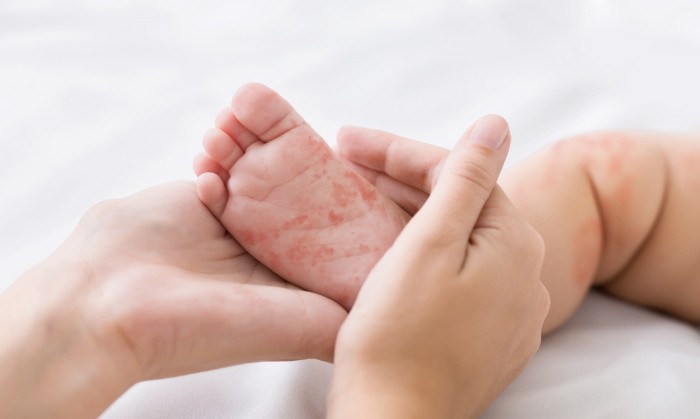
Measles in Children: Parents and Grandparents
This post may contain affiliate links. We may earn a commission if you purchase via our links. See the disclosure page for more info.

As a parent or grandparent, protecting your children and grandchildren from preventable diseases is one of your top priorities. Measles in children, once nearly eliminated in many countries, has seen concerning resurgences in recent years. This comprehensive guide will help you understand measles, recognize its symptoms, and make informed decisions about protecting your family.
A friend in Southern Utah mentioned that all ten of their children contracted measles in January. I remember when I was in Kindergarten many years ago, the school lined us all up and gave us each a smallpox shot. Another time, they gave us the polio vaccine (sugar tablets) at school. I wonder if there was any paperwork. I doubt it. It’s been too many years. My father was in an iron lung for polio, and my older sister contracted polio as well. I can’t imagine how my mother felt. She had to ask family members for help. She was spread thin trying to raise her three daughters, I’m sure.
PLEASE NOTE: I’m not advocating for or against Vaccinations. I’m not a doctor, nurse, or anyone in the medical field; I just try to help my readers stay informed about important current topics and trends so they can protect their loved ones.
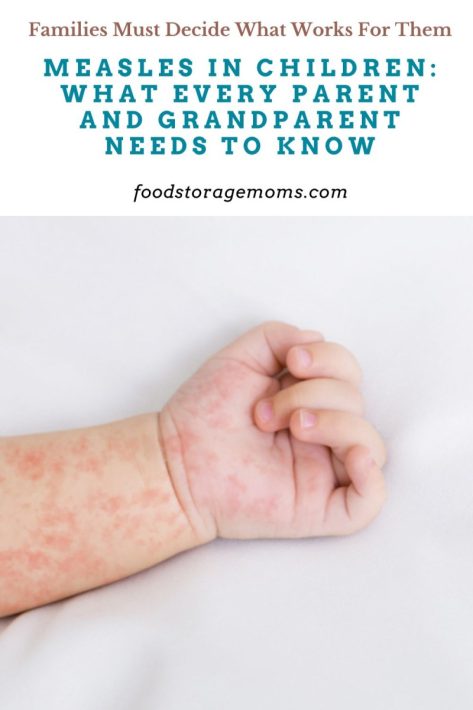
What Is Measles and Why Should You Care?
Measles is a highly contagious viral infection caused by the rubeola virus. It spreads through airborne droplets when an infected person coughs or sneezes, and the virus can remain active in the air or on surfaces for up to two hours.
How Contagious Is Measles Really?
Measles is one of the most contagious diseases known to medicine. If one person has measles, up to 90% of unvaccinated people who come into close contact with them are likely to become infected. This means that in a room of 10 unvaccinated children, if one has measles, approximately 9 others will likely catch it.
The History of Measles: From Common Childhood Disease to Preventable Threat
Before the measles vaccine became available in 1963, nearly every child contracted measles by age 15. In the United States alone, measles causes an estimated 3 to 4 million infections annually, resulting in approximately 48,000 hospitalizations and 400 to 500 deaths each year. Thanks to widespread vaccination, measles was declared eliminated from the U.S. in 2000. However, outbreaks still occur, primarily among unvaccinated populations.
Recognizing Measles Symptoms in Children
Early recognition of measles symptoms can help you seek prompt medical care and prevent further spread to vulnerable family members.
The Classic Four-Stage Progression of Measles
Incubation Period (10-14 Days). Right after exposure to the virus, there are typically no symptoms. Your child appears healthy but is developing the infection internally.
Prodromal Stage (2-4 Days) This is when the first symptoms appear:
- High fever (often 104°F or higher)
- The “three Cs”: Cough, Coryza (runny nose), and Conjunctivitis (red, watery eyes)
- Fatigue and general malaise
- Loss of appetite
- Koplik spots (tiny white spots with red halos inside the mouth, appearing 2-3 days before the rash)
Rash Stage (3-5 Days) The characteristic measles rash typically appears 3-5 days after symptoms begin:
- Starts as flat red spots on the face at the hairline
- Spreads downward over 3-4 days to the neck, trunk, arms, legs, and feet
- Spots may become raised and join together
- The rash typically lasts 5-6 days before fading
Recovery Stage: The rash fades in the same order it appeared, often leaving a brownish discoloration that eventually disappears.
When to Call the Doctor Immediately
Contact your healthcare provider right away if your child:
- Has been exposed to someone with measles
- Develops a fever above 104°F
- Shows signs of difficulty breathing or chest pain
- Becomes increasingly lethargic or confused
- Develops severe headache or vomiting
- Shows signs of dehydration
Serious Complications: Why Measles Isn’t “Just a Rash”
Many people remember measles as a common childhood illness, but it can lead to severe and even life-threatening complications.
Common Complications Affecting Children
Ear Infections: About 1 in 10 children with measles develop an ear infection, which can lead to permanent hearing loss if not properly treated.
Diarrhea: Approximately 1 in 10 children with measles will experience severe diarrhea, which can lead to dehydration, especially in young children.
Pneumonia: Up to 1 in 20 children with measles develops pneumonia, the most common cause of measles-related deaths in young children.
Rare but Devastating Complications
Encephalitis (Brain Swelling) About 1 in 1,000 measles cases develops encephalitis, which can lead to seizures, deafness, or intellectual disability. Approximately 1-2 children out of every 1,000 who get measles will die from complications.
Subacute Sclerosing Panencephalitis (SSPE). This fatal degenerative brain disease can develop 7-10 years after measles infection. It’s rare (affecting about 1 in 10,000 cases) but inevitably fatal. Children who contract measles before age 2 are at the highest risk.
Special Risks for Vulnerable Populations
Certain groups face higher risks from measles:
- Infants under 12 months (too young for standard vaccination)
- Immunocompromised individuals (those with cancer, HIV, or those taking immunosuppressive medications)
The MMR Vaccine: Your Best Protection Against Measles
The measles, mumps, and rubella (MMR) vaccine is safe, effective, and the best way to protect your family from measles.
Recommended Vaccination Schedule
For Children:
- First dose: 12-15 months of age
- Second dose: 4-6 years of age (before entering school)
For Adults: Adults born after 1957 who haven’t had measles or haven’t been vaccinated should receive at least one dose of the MMR vaccine.
How Effective Is the MMR Vaccine?
The MMR vaccine is highly effective:
- One dose is about 93% effective at preventing measles
- Two doses are about 97% effective at preventing measles
Even if a vaccinated person does contract measles (breakthrough infection), they typically experience a milder illness with fewer complications.
Addressing Common Vaccine Concerns
“I’ve heard vaccines cause autism.” Multiple large-scale scientific studies involving millions of children have conclusively shown no link between the MMR vaccine and autism. The original study claiming this connection was retracted due to serious ethical violations and fraudulent data.
“Natural immunity is better than vaccine immunity.” While natural infections provide some immunity, the risks far outweigh the benefits. Getting measles means risking serious complications, hospitalization, and even death. Vaccine-induced immunity provides excellent protection without these risks.
“Too many vaccines overwhelm a child’s immune system.” Children’s immune systems handle thousands of antigens every day from their environment. The antigens in vaccines are a tiny fraction of what children encounter naturally.
What to Do If Your Child Is Exposed to Measles
If you believe your child has been exposed to measles, quick action is important.
Immediate Steps to Take
- Call your healthcare provider immediately: Don’t just show up at the office, as this could expose others. Call ahead so they can make special arrangements.
- Check vaccination records: Fully vaccinated children (two doses of MMR) are at very low risk.
- Consider post-exposure prophylaxis: For unvaccinated children, administering the MMR vaccine within 72 hours of exposure may prevent measles or reduce its severity. Immune globulin can be given within 6 days of exposure for those who can’t receive the vaccine.
- Monitor for symptoms: Watch for fever and other symptoms for 21 days after exposure.
- Isolate if infected: Keep infected individuals away from others for 4 days before the rash appears and for 4 days after.
Protecting Infants Too Young for Vaccination
Babies under 12 months old cannot receive the standard MMR vaccine, making them particularly vulnerable:
- Breastfeeding provides some passive immunity if the mother is immune
- Maintain high vaccination rates in the community (herd immunity)
- In outbreak situations, infants as young as 6 months may receive an early MMR dose
- Limit exposure to large crowds during outbreaks
Caring for a Child with Measles at Home
If your child contracts measles, most cases can be managed at home with supportive care.
Home Care Essentials
Fever Management
- Use acetaminophen or ibuprofen as directed by your pediatrician (never give aspirin to children)
- Dress your child in lightweight clothing
- Offer plenty of fluids to prevent dehydration
Comfort Measures
- Keep your child’s room dimly lit, as light sensitivity is common
- Use a cool-mist humidifier to ease a cough and sore throat
- Encourage rest and quiet activities
Nutrition and Hydration
- Offer small, frequent meals
- Provide plenty of fluids (water, diluted juice, clear broths)
- Popsicles and ice chips can be soothing
Preventing Spread
- Keep your child home and isolated
- Practice good hand hygiene
- Disinfect frequently touched surfaces
- Notify the school or daycare
When Hospitalization Is Necessary
Seek emergency medical care if your child shows:
- Difficulty breathing or rapid breathing
- Dehydration (dry mouth, no tears, decreased urination)
- Severe headache or stiff neck
- Seizures
- Confusion or altered consciousness
- Chest pain
Measles in the Modern World: Understanding Recent Outbreaks
Despite an effective vaccine protocol, measles outbreaks continue to occur worldwide, including in developed countries.
Why Are We Seeing Measles Outbreaks Again?
Several factors contribute to measles resurgence:
Declining Vaccination Rates: In some communities, vaccination rates have fallen below the 95% threshold needed for herd immunity. This leaves pockets of vulnerable individuals where measles can spread rapidly.
International Travel: Measles remains common in many regions worldwide. Unvaccinated travelers can reintroduce the virus into their communities.
Vaccine Hesitancy: Misinformation about vaccine safety has led some parents to delay or refuse vaccination for their children.
Protecting Your Community Through Herd Immunity
When approximately 95% of a community is vaccinated against measles, it creates “herd immunity” or “community immunity.” This indirect protection helps safeguard those who can’t be vaccinated, including:
- Infants too young for vaccination
- People with weakened immune systems
- Those with legitimate medical contraindications to vaccination
By vaccinating your children, you’re not only protecting them but also helping to protect vulnerable members of your community.
Talking to Your Adult Children About Vaccinating Your Grandchildren
As a grandparent, you may feel concerned if your adult children are hesitant about vaccines. I won’t provide vaccination advice for my grandchildren. It’s not my place; they are NOT my children, and the parents must make the decision that is correct for their family. Here’s how to approach this sensitive topic.
Tips for Productive Conversations
Listen First: Understand their specific concerns before offering information. Are they worried about vaccine safety, ingredients, timing, or something else?
Share Your Experience: If you lived through the pre-vaccine era, share what it was like when measles was common. Personal stories can be powerful.
Provide Reliable Information: Point them to trusted sources such as the CDC, the American Academy of Pediatrics, or their pediatrician, rather than relying on anecdotal evidence from social media.
Respect Their Role as Parents: Ultimately, they make the decisions for their children. Offer information and support without being pushy or judgmental.
Emphasize Love and Safety: Frame the conversation around your shared goal: keeping the grandchildren healthy and safe.
Recommended Resources for Parents and Grandparents
- Centers for Disease Control and Prevention (CDC): www.cdc.gov/measles
- American Academy of Pediatrics: www.healthychildren.org
- World Health Organization: www.who.int/health-topics/measles
- Immunization Action Coalition: www.immunize.org
Making Informed Decisions for Your Family’s Health
Understanding measles, its complications, and the protection offered by vaccination empowers you to make the best decisions for your family.
Key Takeaways for Parents and Grandparents
- Measles is highly contagious and can lead to serious complications, including death
- The MMR vaccine is safe, effective, and the best protection against measles
- Two doses of the MMR vaccine provide 97% protection against measles
- Early recognition and medical care are important if measles is suspected
- Community immunity protects those too young or unable to be vaccinated
- Recent outbreaks remind us that measles remains a threat when vaccination rates decline
Your Next Steps
- Check that your children and grandchildren are up to date on MMR vaccinations
- Review your own vaccination status (adults may need a booster)
- Talk to your healthcare provider if you have questions or concerns
- Help combat misinformation by sharing accurate information about vaccines
- Support public health efforts to maintain high vaccination rates in your community
35 OTC Medications You Should Store
30 Items You Need To Survive A Pandemic
Final Word
Protecting your family from measles doesn’t have to be complicated. With accurate information, timely vaccination, and community cooperation, we can keep our children and grandchildren safe from this preventable disease. Your pediatrician or family doctor is always your best resource for personalized advice about your family’s specific health needs. This must be YOUR decision to do what is right for your family. May God bless this world, Linda
Copyright Images: Measles on Hand With White Background AdobeStock_1237265468 By Prostock-studio, Measles on The Bottom Of A Baby’s Foot AdobeStock_875978384 By Prostock-studio








Sorry but your right to not get your kids vaccinated stop at your front door. When you decide to interact with the community at large, there may be consequences for your actions. Maybe you have to home school. Maybe you don’t get to go to certain places because your decision as a parent will affect those around you. Or you can be like everyone else and vaccinate your kids.
Hi James, great comment, thank you. I debated about writing about the measles until I read where someone I knew in Southern Utah that her whole family broke out with them. My oldest daughter was born in 1970 and all of my four daughters were vaccinated with the MMR shot. A few years later our pediatrician said they needed a second one, I can’t remember why. I could Google it, but I do remember taking them and getting the second one per my doctors suggestion. I will Google it now because there was a reason for it and I just can’t remember. Okay, I looked it up, “Some children vaccinated between 1963 and 1967 received an inactive, “killed” virus vaccine that did not provide long-term, lasting immunity, notes the CDC ( Centers for Disease Control and Prevention | CDC (.gov).” A recommendation for the second dose of the measles vaccination was introduced in 1989. Linda
My oldest brother entered school in 1961 and within the first 3 or 4 years, he caught and shared chicken pox, measles, German measles, mumps, etc. By the time I entered school I had all the diseases. As for lining everyone up an giving vaccines at school, my mother had the vaccine cards from where my brothers and I were given the polio vaccine at school. I was 3 years old and went to a half day “play school”. I used to have the vaccine card and somehow misplaced it. The card said that I was given the live polio vaccine on a sugar cube.
Just because I always wonder how things work and this is a topic I would love to sit down and discuss with someone who studies viruses. Once a human gets a virus, while your body is fighting the virus, your body is also making more viral “cells”, and making immunity to the virus all at the same time. After you recover every time you are exposed to the virus, your body releases the immunity, which helps build your immunity. My question is what happens if you are never exposed to the virus again? Does your immunity stay the same? Does it slowly reduce? For those of us who had measles, and because of the vaccine have never been exposed again, what would happen if we were exposed today?
Hi Topaz, great story you shared. Thank you. When I was growing up I got measles, German measles, and chicken pox. My sisters and I never got the mumps. I don’t remember a vaccine card, my mom has passed so I can’t ask her. My father and sister got Polio. We were scared to even go outside and play for fear we could get Polio, that’s all I remember. I wish I knew more about immunity, I saw a friend with Shingles, and I do not want to get that. Linda
I meant to ask my doctor the immunity question but I had so many other questions that I didn’t get to the hypothetical. My sister’s mother-in-law got Shingles and it was nasty. I need to get that vaccine, I just keep forgetting…. or maybe avoiding.
Hi Topaz, it’s hard to remember everything when we go to the doctor. Shingles is so painful, I have heard. Linda
I had all the childhood diseases: measles, mumps, chickenpox. And had all my vaccinations in school. My children had all of their vaccinations, and my grandchildren, but not all of my great-grandchildren. One has never been vaccinated. It really scares me.
My husband went to school with a girl whose dad would not let her get the polio vaccine. Guess who was the only one to get it. Yep, she spent her life in a wheel chair.
Hi Deborah, wow, that’s tough for the girl who ended up in a wheelchair. I think my father and sister got Polio before there was a vaccine. He was in an iron lung a long time my sister contracted polio but did not had any longterm issues. She was born in 1948 so I am not sure about the details. Sad for my ine, I’m sure. Linda
It was. He always felt guilty. It’s sad. Larry was born in 1949.
HI Deborah, wow, I can’t imagine how a parent would feel after their child contracted Polio and then had complications. That’s a tough one. Linda
My thoughts exactly! If there hadn’t been a vaccine, that’d be a different story. But, too many parent are still afraid of vaccines. I’m not and believe in them for children! But, I only took 2 Covid vaccines. Why? We don’t go out in public. And I did wear a mask when I did, when it was so bad. The places we’ve been since Covid started was the grocery store, doctors offices, and hospital when we had to go. Still where we go.
We were exposed to the flu during Christmas, from a family member who didn’t have any symptoms, but didn’t get sick. No flu shot though. Never had one. It’s been 30-40 years since I had it. Larry the same.
Hi Deborah, I think I got Covid before we knew it WAS Covid. It was right before my 70th birthday January 2020). I felt sick, tired, and couldn’t walk ten feet without stopping. We had planned a trip (cheap through my daughter who works at an airlines) she was our trip director through Paris and England. I could hardly breathe, we were in Paris at the Chinese New Year celebration! The beautiful Chinese dancers all had masks on, we had just barely heard about Covid. LOL! We were gone ten days and I kept saying I am not going to a hospital in Paris or England. We took the subway everywhere, saw men pick pockets, I yelled at one as I was coughing. Funny but not funny looking back. LOL! Linda
Guess I’m too old. In the early 1950’s if parents heard of some child having measles, chicken pox or mumps it wasn’t stay from them but go play with them so you could get them and get it over with. Just hope you had mumps on both sides, or later you might have to get them again. Had all three that way and in a few more days, I’ll be 80 so I guess I survived them like all the other kids I knew that got them. Don’t recall even one death from any of them. Guess the chicken pox is why I had shingles several years ago. Don’t remember when I got the small pox vacation if we had to have parents permission, just remember having a scab over a quarter around that I shouldn’t pick at.
Speaking of an iron lung, I remember a veteran I met in the Long Beach Veterans Hospital about the fall of 1967. I forget how long he had been there in it, but I do remember the smile he always had and how happy he seemed to be. The times I met his wife, she also seemed happy with a smile all the time. I never met his two daughters as they were both attending BYU. If no one was visiting him, he spend most his time on his back in the iron lung; read books by turning the pages with a wooden stick. I have thought if only I could be half as happy as him and his wife. I should be happier. I’ve never be stuck all the time in an iron lung.
Hi Chester, I remember having my kids play with the neighbors to get the chicken pox over with. A few had them and we let our kids play together so the chicken pox would be over before our trip was planned to go to Disneyland. Some got them others did not. I think by then all of our kids had had the MMR shot. I don’t remember for sure, but I know none of them got the mumps. In 1967 I would have been 17 and my father was not in the iron lung at that time. It would have been back in 1950-1952, I wish I knew the exact dates when he contracted polio. I remember the smallpox scab, it was huge for a skinny arm. Linda
I contracted measles when I was 5 years old. This was before the MMR vaccine was available, otherwise my parents would have vaccinated us kids. My sister and I came down with measles at the same time and she recovered fairly quickly. I, on the other hand, developed encephalitis which nearly killed me and I was hospitalized. I will forever live with the complications, mainly being almost completely deaf. I wear hearing aids and the new ones are a great improvement, but it’s not like having my own natural hearing. I’m not a big one to push vaccines, but I believe this one is a must, and I’m living proof of what can happen when not vaccinated.
Hi Paula, oh my gosh, thanks for sharing your story, wow, you are lucky to be alive. Encephalitis, and loss of hearing is so serious. I sure wish I could remember the ages or dates when I had the measles. I still remember being told do not go near the water in the gutters. I guess my family thought we could get polio from the water in the street gutters, I don’t know. Linda
Yes, I don’t remember much about the hospital but I do remember how serious my parents were.
Hi Paula, oh your parents must have been so worried. Linda
I got all my childhood illnesses from having older siblings that were in school. LOL Sister wanted hers back because I was getting too much attention. So I was told, anyway. LOL
Hi Deborah, oh that’s hilarious! You got all the attention, love it! Linda
Hi Linda, hope everyone is well. I just finished watching the 11 o’clock tonight and heard there is a case of measles in New York City. The reporter said 1 case, I think there are more, we just haven’t heard. I also had all (but the mumps) ‘childhood’ diseases have been born in 1948. My oldest son came home with the chicken pox in 1977 and infected his brother and sister, there was a major outbreak in several schools in New York City at that time. At that time there was no chicken pox vaccine available. By 1981, when my last son was born there was a chicken pox vaccine available and all 4 of my children were vaccinated. All I can say, is to be careful, if you think you were exposed call your PCP and asked them what to do. Happy Valentine’s Day and have a good weekend.
Mildred Stephens
Hi Mildred, thank you for sharing your story. I’m not sure I knew anyone who got the mumps, that I can remember. I wish they had had the Chicken Pox vaccine when my girls were little. It was an awful disease. Luckily they didn’t get any scars from them. Happy Valentine’s Day!! Great reminder, Linda