
How To Freeze Corn On The Cob
This post may contain affiliate links. We may earn a commission if you purchase via our links. See the disclosure page for more info.

Today, I want to demonstrate how to prepare corn on the cob for freezing. Or should I say, prepare our corn off the cob for the freezer? I prefer to blanch and scrape the kernels off the cob itself, and then use a FoodSaver to remove the air from the storage bags before freezing the corn. Mark and I went out to a small community called Enterprise, Utah, for the city’s CornFest festival.
I originally posted this in September 2016, then again in 2025. I felt it needed an update, so here we go. Here’s to preserving fresh corn.
It was so fun, and the corn is the best in the state of Utah, or at least in Southern Utah, according to the folks from Enterprise! Gotta love it!! Do you love the white and yellow corn on the cob as much as I do?
When it comes to eating corn on the cob, we put a cube of butter on a plate and insert the corn holders into the cob, then roll the corn in the sweet butter. Be sure to have the salt and pepper ready to sprinkle over the melted butter. Is your mouth watering yet? Mine sure is!
History of Corn
Corn, also known as maize, has been cultivated for roughly 9,000 years, with its origins traced back to a wild grass called teosinte in what is now southern Mexico. Indigenous peoples across the Americas developed corn into a staple crop long before European contact, breeding it into hundreds of varieties suited to different climates. Corn was so central to many Native American cultures that it was often referred to as one of the “Three Sisters,” grown alongside beans and squash in a mutually beneficial planting system.
When European explorers arrived in the Americas, corn quickly spread across the world, becoming a dietary staple in Europe, Africa, and Asia. In the United States, sweet corn, the variety most of us grow in our gardens and freeze for winter use, was developed from field corn varieties and became popular in the 1700s and 1800s. Preserving corn for the colder months has a long history too, with early methods including drying kernels on the cob or grinding them into meal. Freezing corn became a widely used method once home freezers became common in the mid-1900s, giving families a way to enjoy that fresh-picked taste all year long.
Nutritional Value of Corn
Corn is a good source of energy and offers several nutrients that make it a valuable addition to a self-reliant pantry. A typical serving of corn provides:
Carbohydrates for energy, primarily in the form of starch
Fiber, which supports healthy digestion
Vitamin C, an antioxidant that supports the immune system
Thiamin and other B vitamins, important for energy metabolism
Folate, which is especially important for cell growth and function
Magnesium and potassium, minerals that support muscle and nerve function
Small amounts of protein
Corn also contains antioxidants such as lutein and zeaxanthin, which are associated with eye health. Freezing corn shortly after harvest helps lock in these nutrients, since fresh produce naturally loses some vitamin content the longer it sits before preservation. This is one of the reasons freezing corn at peak ripeness is such a smart practice for families who want to stretch the harvest season and still get good nutrition out of their stored food.
Here’s the deal: I’m a big-time canning safety person. I use the Ball Blue Book Guide or the USDA Canning Guide to preserve food, ensuring I have the preparation and cooking times spot on for safety. Let’s get started with my suggestions, which are based on the times mentioned in the book stated above.
Kitchen Items You May Need:
How To Freeze Corn On The Cob
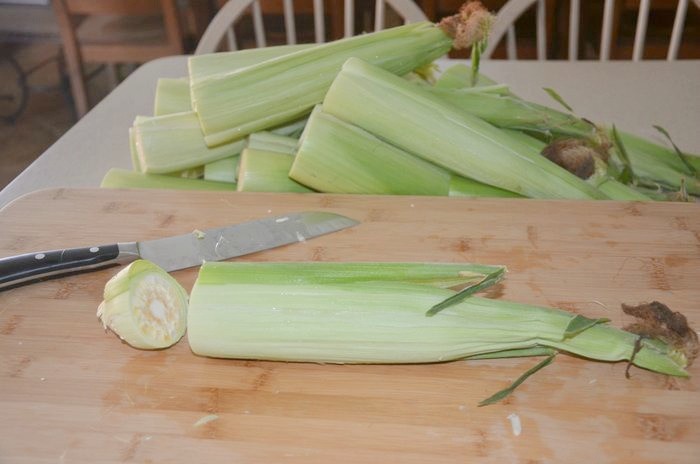
Step One: Cut the Ends Off of the Corn Cobs
When you cut the ends off each cob, it makes the next step, “shuck” the husk (outer covering) from the cobs, easier.
Step Two: Shuck the Corn From the Cobs
I have this huge chopping board that I’ve had forever. If you keep it oiled with mineral oil, it should last a lifetime, literally. I have one similar to this one, a sturdy cutting board. I learned a trick from my son-in-law, Nate, on how to shuck corn on the cob. You take a very sharp knife and cut the hard ends off.
Step Three: Remove the Silk
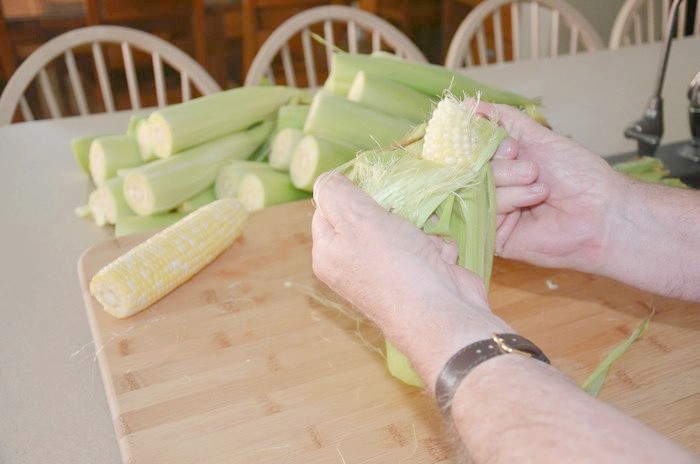
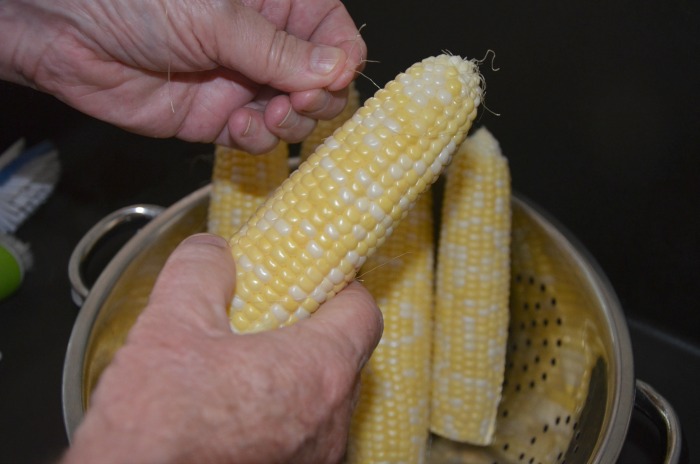
Next, you grab the top of the corn and pull off the outer green leaves (husk) with the silk attached. Now, you’ll still have a few strings of silk as shown below, but I have a solution for that as well.
Step Four: Scrub the Silk Off
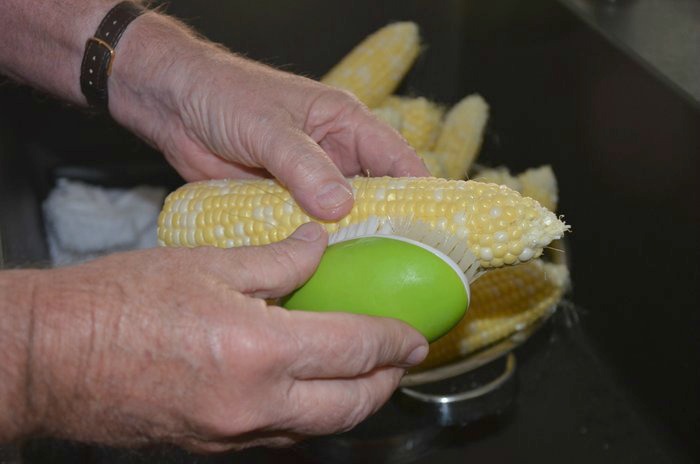
As I wash the corn, I use a small vegetable scrubber that my daughter, Heidi, gave me for my birthday one year ago. It is awesome for almost every vegetable. As you scrub the bristles across the corn, it removes about 99.9% of the silk. That works for me. OXO Good Grips Flexible Vegetable Brush
Step Five: Scrubber
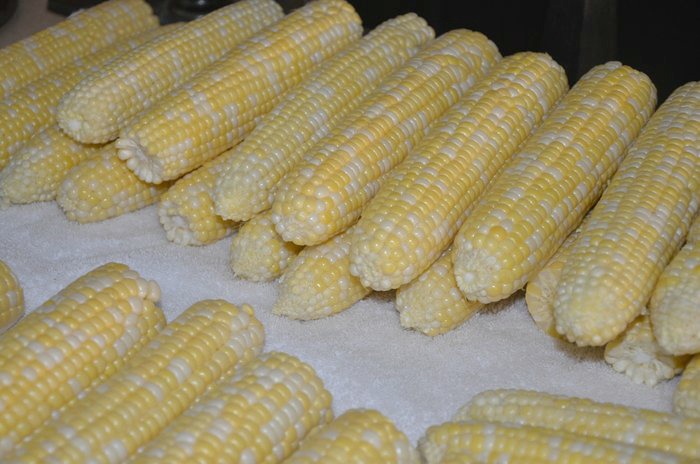
I prefer freezer corn over canned corn because, to me, the canned corn in a jar is too mushy. But if your power or your freezer goes out, those jars of corn will taste mighty good, right? We’re now ready to start the cooking process.
Step Six: Blanch the Corn
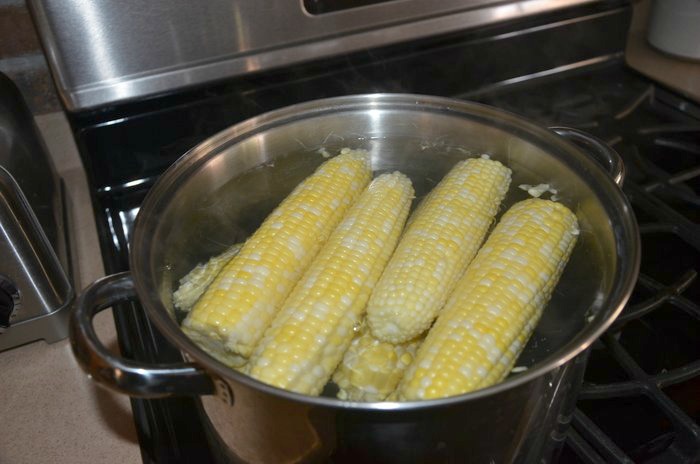
This is really a good little scrubber. Now get a large pot or pan of water and get it to a rolling boil. Once you see that the water is boiling, gently place as many of the cobs of corn as you have in the boiling water. Set the timer for 5-6 minutes.
This is what we call “blanching” the corn. Use a pair of good tongs to remove the hot ears of corn, so you don’t burn your hands. You could drain the hot water before using the tongs if you want to be extra careful.
Step Seven: Prepare to Ice the Corn
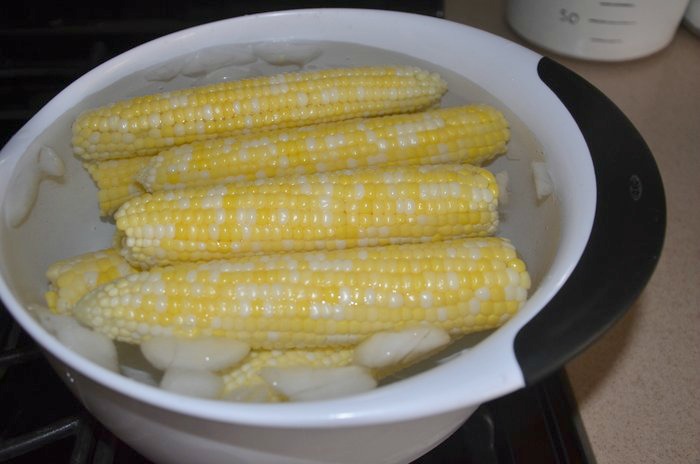
Grab a large bowl and fill it with ice water and ice cubes.
Step Eight: Put the Blanched Corn in the Ice Water
After blanching, quickly submerge the hot ears of corn in ice-cold water for the same amount of time you blanched them (5 to 6 minutes). Some cooks would refer to this as an ice bath. After the cooling time, remove the cobs and pat them dry on a clean towel.
Step Nine: FoodSaver – Package the Corn
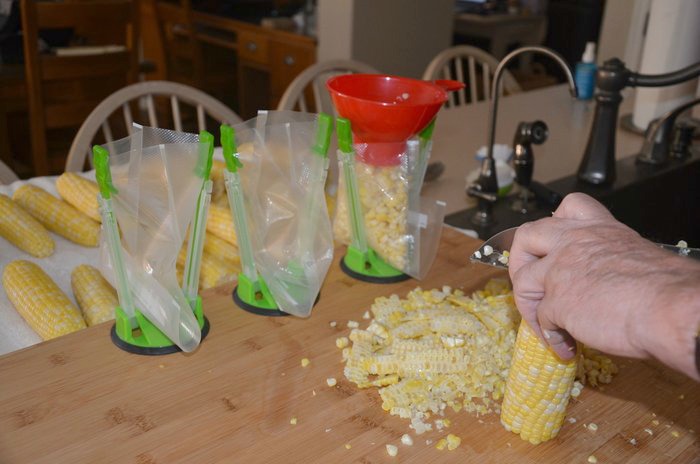
I’ve tried just about every corn-on-the-cob scraper, and they don’t work as well for me as a sharp knife. The bag holders shown above are the ones I’ve used for other purposes, but they didn’t work as well for filling the bag with corn kernels. I ended up using my hands (they were clean) and filled the funnel with corn as shown above. Here are the Bag Holders.
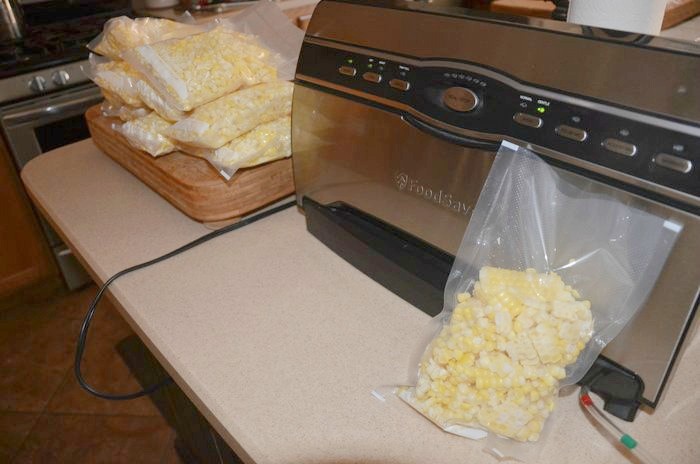
I use my FoodSaver for so many things, so I tend to keep it right where I can use it at the drop of a hat, so to speak. This is similar to the one I have: FoodSaver. Besides removing air from the bags, the unit provides an airtight seal, ensuring the corn stays as fresh as possible. Fresh produce means a great flavor when you add the corn to a meal. Note that Costco has advertized FoodSaver units on sale this month.
Now we’re ready to store the corn in some free space in your freezer. I make a bunch of medium-sized bags so they’re ready to pull out of the freezer and use as part of a meal. I usually label the bag with the date I processed the corn, so I know how long it’s been stored.
The cream cheese corn recipe outlined below is one of my favorites.

- 2 pounds frozen white super sweet corn
- 8 ounces of cream cheese
- 1/2 cup of butter
- 2 tablespoons sugar
- 2 tablespoons water
-
Combine the ingredients in order in a slow cooker and cook on low for 3-1/2 hours or until cooked through. Serve warm. This is so yummy!!
How long will the frozen corn be good in the freezer?
I’ve had my corn in the freezer for about six months, unless we eat it before that timeline expires. Keep in mind, I use a FoodSaver, and I believe that makes all the difference in helping the corn last longer. Years ago, before I had a FoodSaver, I used freezer bags; they work, but not for as long because they still contain air.
Will it get freezer burn?
Well, it could get freezer burn, but when I use my FoodSaver, it’s as fresh as the day I bagged it before placing it in the freezer.
Can I freeze the whole cob?
I know you can, but I’ve never liked the texture outcome. It always seems too squishy. So, I’ve been freezing it off the cob for over 50 years.
Can I make corn chowder with this corn?
Yes, you can. In fact, I have the best recipe for corn chowder. In case you missed this post, The Best Corn Chowder Recipe
Can I use this corn in soups?
Yes, it’s perfect for soups or stews. Actually, any corn recipe can benefit from using this frozen corn, including homemade salsas.
Final Word
Let me know if you’ve frozen or canned any corn this year. I love hearing your stories! Please stock up; we must. There’s a chance that we may experience a shortage of many vegetables this year, based on the adverse effects of both drought and flood conditions on various areas. May God bless this world, Linda
Copyright Images: Creamed Corn Depositphotos_168772654_s-2019






Linda, that looks so good. I have not had corn for five years since I realized that 90% of the corn was GMO. Are you getting your corn from an organic farmer? Would love to know where to purchase some.
thanks,
Vivian, I’m with you WRT GMO anything, especially since the food/caloric value isn’t what “real” food has these days.
I’d LOVE to grow my own non-GMO corn but, by golly, it takes a lot of room to grow enough to make it worthwhile and given the nature of the beast, it isn’t a good return on the effort since it seems rare to find more than two or three ears per corn stalk.
And as much as I prefer to go organic, with NO true government regulations specifying what is required to meet what would be construed as TRUE organic, it isn’t really possible to know if you are getting an honest organic product given the lack of oversight to ensure it really is.
Also, while I much rather prefer to support the few (read distant from me) Farmers Markets and the cost they pass on to the consumer, it can be a real chore to eat organic or non-GMO foods and stay within a realistic budget.
I don’t begrudge anyone from making a living and providing a much needed and oftentimes neglected service or product, but anyone trying to buy quality foods and stay within a budget is hard pressed to do so in this day and age.
Considering I am “mobility challenged” (disabled), putting in a garden and working it to help provide and supplement my groceries is a hard thing to accomplish. Especially living on my own and in the desert southwest where the heat can be very oppressive during the growing seasons.
What would be nice would be to get with my neighbors who would be interested in doing something similar and we all work together, helping each other in a co-op spirit, and exchanging different produce. Perhaps if some would concentrate on one or more produce items and others something different, we could all take advantage of swapping beans for lettuce, onions for beets, cabbage for corn and so on.
That way, each could concentrate on learning to grow and provide a specific item (s) and become proficient in those items. Of course, we could work out a schedule where we trade off what is grown each season to allow the soil to rest periodically and not strip out too many of specific nutrients and cause growing issues as time goes by.
Sorry if this is long winded. I tend to get spooled up when I get excited and discussing gardening or other topics related to eating healthier.
Since businesses are in the business to make money with as little effort expended to make the best margin and stay in business, I can’t really blame them but it is the CONSUMER who ultimately suffers to some degree from the practice.
I suppose that is the world we live in this day and age.
God Bless and Good luck in your quest to find a good source for your needs. 🙂
Hi Howard, oh man would that ever be a great idea to have a co-op type neighborhood to learn to grow food and share the wealth with each other! You are never long winded to me, I love hearing from you! It’s so frustrating what the cost of food is today! I grow a garden but it’s so hot here in the southwest that the pests, critters, etc. eat the crop before Mark and I do! LOL! The consumer for sure suffers, I wish we could take back our government and run things like our ancestors. I do not know how families feed themselves with the price of food. I know there is a neighborhood about one mile from me that is low-income housing and most are on food stamps (EBT cards). I can only say I pray God will bless all of us in the future because I believe we have only seen the beginning of what is to come. God bless you and Linda! Hugs! Linda
Hi Vivian, I doubt that it’s organic corn. I only buy the fresh corn once a year to support the local farmers and I enjoy every bite. As far as the GMO that bugs me as well. I do not know what seed they used or pesticides. I worry about the water in our government controlled water supplies now as much as the chemicals, seeds, and pesticides. Who would have guessed we would ever have to worry about this stuff! Hugs, Linda
Howard, good to see people getting excited, especially at our age. LOL…I tried to grow corn but it did not work well. I will keep trying as I refuse to eat corn that is GMO by Monsanto. If the pesticide can burst open the belly of the insects, then ..hmmm…after many years what is it doing to mine. As much as I love it I cannot bare to purchase it anymore.
My little garden is now beds of food and is a work in progress. Next year I will know not to crowd everything in one bed. Also, to grow larger tomatoes as I realized I do not care for cherry tomatoes. The kale turned out wonderful and I ended up drying that and storing for soups. The broccoli must have a padding around the base of each plant to keep a particular pest from laying eggs and eating the baby plants. It worked well but still not as good as I expected. The broccoli shot up too fast and kind of exploded before it could really produce. I think it may be my soil. Potatoes are easy to grow. Maybe you could try that as they just need to be in a tub with draining holes, dirt, a little straw layered and cut up potato eyes. Just let the potato eyes dry out before planting. I try and plant them during a full moon. Hopefully, you can get out and about enough to do that and enjoy the sunshine and cool breezes. You have a very good idea of getting the neighbors involved. You can grow the potatoes. eh?
Good luck with that my friend and may God bless and keep you in His care.
Linda, it is doubtful that the corn is organic. Monsanto has all corn tied down to their seeds. I am such an activist against Monsanto since I realized that if you own the food, you own the people. Did you know that some countries in Europe have refused Monsanto’s seeds? They may be more awake than us as all we seem to be able to do is walk around staring at a square box in our hand. LOL…BTW…my phone is old fashioned flip phone. yes, I am a dinosaur and proud of it, by golly. (big toothy grin)
So not to take away from you lovely article of corn. Believe me, my mouth waters every time I see your pictures.
Good to talk to you again, my friend. May God bless you and keep you in His care.
Vivian
Cincinnati, Ohio
Hi Vivian, I love hearing you are an activist against Monsanto! I really wish we had more control than Pharma and Monsanto! It’s so good to talk to you too! We think alike! Hugs! Linda
Vivian, I think a garden is always a learning curve for all of us! One year I grew so much zucchini I couldn’t give it away! This year my tomatoes did not fare well at all. I mean I had enough for several bacon, lettuce and tomato sandwiches but not enough to make salsa like last year. I froze so many tomatoes last year with peelings and all and then used my blender to pulverize them for soups, etc. I had to give up the cherry tomatoes, we couldn’t pick them fast enough! LOL! I’ve never tried broccoli, but potatoes are easy, very easy and taste so fresh. Yes, I buy organic potato seeds. May God bless you as well! Linda
Although I, too, love corn off the cob, munching it straight from the cob adds to a festive meal treat so I freeze my corn whole still on the cob, even though it is bulkier for storage in the freezer.
I learned an important lesson my first attempt, though. Short of dehydrating the whole schmoe, it was difficult to completely remove ALL the moisture so the water being sucked out during the vacuum/sealing process would be successful.
In fact, my first two attempts met with failure.
What I ended up doing was ensuring that I used enough excess bag (yeah, that’s a bummer but necessary I learned, but I can keep the waste down to an absolute minimum AND I can save and reuse the bags later for other purposes. More on that shortly.), and then I took a full sheet of paper towel, folded it up until it was about one inch (1″) wide and placed it sideways across the mouth of the bag (folding the edges to fit side to side) and inserted it in about two inches (2″) into the mouth of the bag and ensuring it laid flat.
Make sure to place it at LEAST that far inside so the FoodSaver can create the proper vacuum and seal without the paper towel obstructing the sealed area.
Once the bag has four ears laying flat, I insert the bag and let the machine do its work.
The paper towel snags any residual moisture and allows the sealing strip to ensure a solid, airtight, seal.
BAZINGA! You are done. Four ears are frozen and the perfect amount for a dinner plus two spares for a leftover meal for my Fiancé, Linda, and I in a day or two.
It was a frustrating time trying to get the process figured out at first but now it is almost as simple as anything else to package.
Oh, lest I forget, I turn down (roll) the mouth of the bag twice before inserting any food to make sure NO liquid ends up in the area to be heat sealed, thus preventing any mishaps.
Now, for salvaging the used bags.
I’m not so frugal (read CHEAP) that I won’t buy replacement bags, but ever the “salvager” I save the bags for other items that are NOT foods since I don’t want the concern of cross contamination even though I wash the bags out thoroughly inside and out.
Well, I’ve found that for items that aren’t food, such as strike anywhere matches, small candles, spare batteries, partial rolls of TP (! Who wants soggy TP?!?) or other items you want to retain without fear of water damage, I cut the bags down (if required) and seal those small items inside.
Ta, DAH! Waterproof whatever! 🙂
This is ideal for those items needing minimal spacing inside of your BOB, GOOD or GHB, AND I’ll also insert a small Ziploc bag inside, too, so if or when you need one item, you’ll have an alternate way to reseal the remainder with at least a modicum of water resistance.
Lastly, I always place a SMALL cut along one or two sides so it is easier to tear the bag open and I’ll mark the slots with a sharpie to make locating them easier.
Well, there you have my suggestions and a few other ideas that I hope others can make use of.
Take care and I really enjoy reading your posts!
God Bless.
Hi Howard, I will have to try freezing the corn on the cob, next time. I looked at Mark after we did these three dozen and I laughed and as I said “I wonder how much corn is at the store, already bagged and ready to cook”! LOL! I love your tips on the FoodSaver, I wish every family could have one in their home. Hugs! Linda
Howdy, Linda and All.
Well, talk about learning curves, I had a dose of reality up side my head this weekend and I need to make an update to putting “COOKED” ears of corn into FoodSaver bags, sealing them under vacuum and then freezing them.
It appears that by completely cooking the ears then pulling vacuum on them, you will actually be crushing the individual moisture laden kernels, which is why I evidently needed a paper towel inside the bag when vacuum sealing the corn.
This hypothesis is borne out due to my cooking (warming) up four ears for dinner this past weekend.
As I pulled the ears out of warming water I noted the kernels weren’t plump and firm but more flaccid and mushy.
Eating the kernels off the cob was a lackluster and disappointing affair to me and my Hunny turned it down after two bites. How sad and disappointed I was.
I’m now of the opinion that I should have just removed the husks and silk, washed the ears thoroughly and towel dried them and THEN vacuum sealed the ears, but NOT letting the device pull a full vacuum before overriding the sequence and instructing it to seal with roughly 1/2 to be 2/3 of a seal cycle, thus preventing the vacuum cycle from crushing the moisture out of the individual kernels and ending up with my experience.
I’d be grateful to learn if anyone else has experienced this phenomenon or not. The whole idea of having “fresh” corn after the growing seasons end without paying big market prices is most appealing to me.
I apologize if I lead anyone astray with my suggestions. It was, admittedly, my first attempt and based on the writings of others but using different veggies.
Who knew? 🙁
I had the best of intentions and will NOT give up in my quest for froze corn on the cob, by golly! I hope to have the time to stop at the market tomorrow and buy just a few ear of corn and try my alternate vacuum sealing attempts.
I let you know what I learn as soon as I can make a determination.
God Bless to All!
Hi, Howard, dang I was so hoping the full cobs of corn worked for you! I had already scraped mine and froze them in bags for the year. Here’s the deal, we are all learning new ways to preserve our food, you rock for trying! I can picture the mushy corn, I bet it’s like when I forget the corn on the cob in the boiling water! LOL! My daughter was telling a trick with boiling corn on the cob. She adds one cup of milk and some sugar. It was delicious! Have a great day my friend, Linda
Hi Linda,
Where did you get the holder to hold your bags open? That would be very handy. Thanks, Becky
Hi Becky, thanks for the reminder, I just added them: https://amzn.to/3g9t04g
Yeah our corn didn’t make due to drought so I picked up some from eastern Oklahoma. I froze it on the cob and it is a little squishy but I don’t mind. I like to grill it with butter and head country dry rub.
I took all our “bad” corn and froze it then thawed it halfway and use it as cold treats for the chickens in our plus 100 days. They love pecking it off and I throw the cob remainder in the compost pile or just mow over them when I’m lazy.
Hi Matt, I love grilled corn!!! I bet the chickens love that treat!! Linda
Linda, I will have to try this recipe. It looks so good and my husband always says anything with cream cheese is a winner! We get our corn from a local farmer and the crop was excellent this year in our part of Kansas. We have cut it off the cob and used the freezer bags to keep it in and suck as much air out as possible. Never had any freezer burn and it all tasted great even 9 months later. I got a vacuum sealer this year and we are hoping the results are the same or better. I’m having too much fun with that vacuum sealer! Of course, I have to pressure can some corn. It’s in my blood to do that!
Hi Paula, thank you for the 5 stars, my friend! Your husband is right on the cream cheese!!!! LOL! I totally get having way too much fun with a FoodSaver! They are the best! Pressure canning is in my blood as well! Great phrase! Linda
You say corn is good in freezer for 6 months…..I have had for 2 yrs and still excellent…..most foods can go way past what is recommended…… Also, to get a great frozen corn on the cob I learned years ago from my mother in law that after boiling, put in ice water and get it so cold that the cob itself is cold….that way no more heat in the ear to make it mushy. Works every time and tastes so fresh!!!!
Hi Sandra, great tip on the whole corn cob. We never make it a year for the corn because we eat it up so fast. 2 years would not surprise me. Frozen corn is delicious! Thank you, I will try the really cold cobs next time!! Linda
Also, I see lately you have been having ads from Collections etc. The flower bushes are great as are their other products…..I have been a happy customer for many, many years……fast shipping and always arrives in great shape….recommend others get their catalogs or check them out on line….they often have sales up to 70% off for clearance.
Hi Sandra, oh that’s wonderful, I love flower bushes, they bring bees and butterflies! I love 70% off as well! Great tip! Linda
I haven’t canned corn or frozen any for the past two years but I may do so this year if the corn prices drop low enough. I have to try Allison’s recipe. It just looks so good.
Hi Ray, thank you for the 5 stars my sweet friend! I need to repost that article. It’s so easy to freeze corn! There is nothing better than fresh corn frozen and you can eat it all winter! That’s my daughter Allison’s recipe. Oh my gosh, its so good! Linda
An update from my post years ago –
We are freezing corn and using the Food Saver. It’s still wonderful even after 12 months in the deep freezer. I’ve also made several jars of my great-grandmother’s corn relish. It brings back so many wonderful memories of sitting at her table in the summertime eating her delicious meals.
HI Paula, oh my gosh, corn relish! I haven’t heard that in years! Thank goodness we have a FoodSaver for frozen corn! There is nothing sweeter in January than corn from the freezer as a side dish! Thank you for the 5 stars, my sweet friend! Great memories, Linda
I had to read this one to see who in the world has freezer space for corn ON the cob? Glad to see it is corn OFF the cob.
Our biggest threat here is power down. After Hurricane Ian we went all over our island clearing out people’s freezers. They had evacuated and couldn’t get back. My friend who is a wonderful cook had a bunch of prepared meals. THOSE we took home and put in our camper’s Propane refrigerator/freezer. Both our house (110 on generator) and that one were then full.
ALL the food from the 15 big freezers we emptied was dumped on the front lawn. If you leave rotting food in the refrigerator/freezer then you have to replace the appliance. Only takes a few days to reach that point. Critters have to eat, too. It was thousands of $$ of food. The beef roasts almost needed us to have funerals for them! But, that’s the reality of it.
We have a 4 months supply of propane for the camper. We use the refrigerator in the house on generator, not running the generator over night to conserve fuel. WHEN that fuel runs out, we can switch to the camper. By the time that is done, we will have used up all the refrigerator/freezer food.
Think that sounds extreme? In 1992 there was ONE big disaster in the USA. Hurricane Andrew. Most of the damage was in S. Miami-Dade county. Everything was normal everywhere else. S. Miami-Dade county did not get power for FOUR(4) months. In the heat of the sub tropics.
Think of the huge diasters all over this country right now. If we have a grid down, how long do you think it will take to get the power back up? And, people, after Hurrican Ian – 4 years ago- there was no way for people with propane generators to get them refilled. Propane trucks ran only for emergency services places like hospitals. Gas generators – we could get gasoline.
The CEO of our power company is a friend. She says there is a 2-3 year back order for ROUTINE parts they need. Longer for the big stuff. They do have some supplies and our grid was rebuilt after IAN. We are in pretty good shape as long as they can get natural gas. Most everything comes from China.
Extra freezers are not the answer to what may be coming. Non-perishable food you will eat is.
Hi CAddison, you know I LOVE this comment. I have one freezer. My thoughts when we lived in Southern Utah, was we would barbecue everyone’s meat or smoke it. Now, we only had to deal with flooding and never lost power for 4 months. Or even one day. The neighbors talked about it. What you had to deal with MANY times is way different. I can’t imagine the stench from the rotten food. Our friends had a son going to school at Tulane University during Hurricane Katrina. They were able to fly he and his family out as soon as an opening came up. They had to leave their house ASAP, and when they returned a year later or so, they had to totally gut the house and throw out every appliance. Mold is dangerous. It’s scary to realize that “parts” for units our cities need to survive are unavailable or back ordered for 2-3 years. Our three power grids that supply power for the entire USA is in the same boat. If they are attacked we may never live long enough to see the power grid restored. I heard they would take years to find the parts if they could find them at all. Just my two cents. Linda
Your last sentence reminded me of something I learned from the amish farm I buy my canning tomatoes every summer.
She told me that she uses an acid.
Without that acid, the corn will not seal or be good for eating.
I bought a dozen ears and used that acid when water bath canning. That corn is beautiful and I check it every time I go to the storage room.
The directions are printed on the envelope which just read ‘Acid For Canning Corn’.
I also learned pickling beets can be done using white vinegar and not ac vinegar.
I will add more sugar to my recipe next time, though.
Enjoy every piece of vegetable you can get while it is still grown.
Hi JayJay, I’m glad you brought this up. People who do not have the latest canning books do not realize the fruits and vegetables have changed over time and it’s a safety issue to add 5% vinegar, food grade citric acid, or real lemon use when water or pressure canning. Thank you, Linda
What I didn’t mention is that the refrigerators/freezers we cleaned out were for the lucky ones – we were told where the hid a key’s were. In our entire area I can’t imagine how many thousands of appliances needed replacing. Remember we had geographically huge flooding – 4 in the last 4 years. We live in a stilt house. No problems.
Add up the flooding now, and there are not enough parts or appliances to come close to replacement.
There are HUGE transformers that take years to get if they need replacing. They are so big/heavy that railways were built to get them in. Many no longer have that access as keeping the rails up didn’t happen.
Most people think it is a crisis if their phone goes down. Most young people (and others, too) sit and wait for help to come that is not coming.
The latest heat domes….well, you already covered that. And the 2 dams that are weeks away from not being able to generate power for 40 million people.
The bosses of our country (and world) try to convince us that survival of the fittest has been overcome. They won. In the convincing only. The reality is what you and so many others know.
It’s not nice to fool Mother Nature! Remember that ad for phony “butter?!”
We live in interesting times and for us, life is good.
Hi CAddison, I read the very same thing about the transformers. They will be impossible to get. I need to write about Hoover Dam, I grew up in Las Vegas, Nevada. Plus, I used to go boating a lot in Lake Powell. Times are scary, people need to know we are in a very precarious situation. Thank you for this awesome comment. It needs to be said. Life is good. Lind
I need to share this for others that have had a bad fungus experience like I had for about 10 years.
I grew tomatoes, green peppers, and cucumbers (in several different locations) in my yard.
I am picking huge ‘delicious’ tomatoes, the ‘size-I-like’ cucumbers, and have one green pepper ready soon.
So, the fungus is gone after 10 years….thank almighty God.
My neighbor saw this and planted one tomato plant in his yard, too.
Hi JajJay, yay fungus is gone! There is nothing better than that first red tomato. YAY! Linda
Linda, as always, you put out the BEST suggestions for whatever topic you are covering! I just have a question to ask your gardening friends in this “forum”: How can you even grow sweet corn, even with organic seeds, if all you get is black smut/mold-covered earts? I have not found a way to get rid of the black smut that ruins the corn everytime!
Thanks kindly, y’all…
JESS
Hi Jess, thank you for the 5 stars, my sweet friend. I have never had that happen to me back when I grew corn. Wow, lets see if anyone else knows. I have never heard of that. Linda