If We Have A War: Can You Feed Your Family?
This post may contain affiliate links. We may earn a commission if you purchase via our links. See the disclosure page for more info.

If we have a war, can you feed your family? I can guarantee you 100% the government won’t deliver food or water to your home in a short time after an unforeseen disaster. When geopolitical tensions rise and supply chains become uncertain, one question becomes urgent for every household: Do you have enough food stored to feed your family?
Wars, natural disasters, and infrastructure failures can disrupt grocery store deliveries within days. Building a pantry stocked with shelf-stable foods is not paranoia; it’s practical preparedness. Canned goods are among the most reliable and affordable options available, offering long shelf lives, nutritional value, and convenience when it matters most.
Whether you’re building an emergency food supply for the first time or reinforcing what you already have, understanding what to stock and why can make the difference between security and crisis. This post breaks down the three essential categories of canned goods every household should prioritize: meats, fruits, and vegetables.
Why Canned Foods Are Your Best Defense in a Crisis
Before diving into specifics, it’s worth understanding why canned foods rank at the top of every serious emergency preparedness list. Most canned goods carry a shelf life of two to five years, with some lasting a decade or longer when stored properly in a cool, dry environment. They require no refrigeration, minimal preparation, and provide reliable caloric and nutritional content. In a grid-down or supply-disrupted scenario, your pantry becomes your lifeline.
Emergency preparedness experts recommend storing enough food to sustain your household for at least 2 weeks, with a 90-day supply considered the gold standard for serious preparedness. Canned goods make that goal achievable on nearly any budget.
If We Have A War, Can You Feed Your Family?
Canned Meats: Protein When You Need It Most
Protein is the first macronutrient group to run short during a food emergency. Fresh meat spoils quickly, and frozen meat becomes unusable once power fails. Canned meats solve both problems.
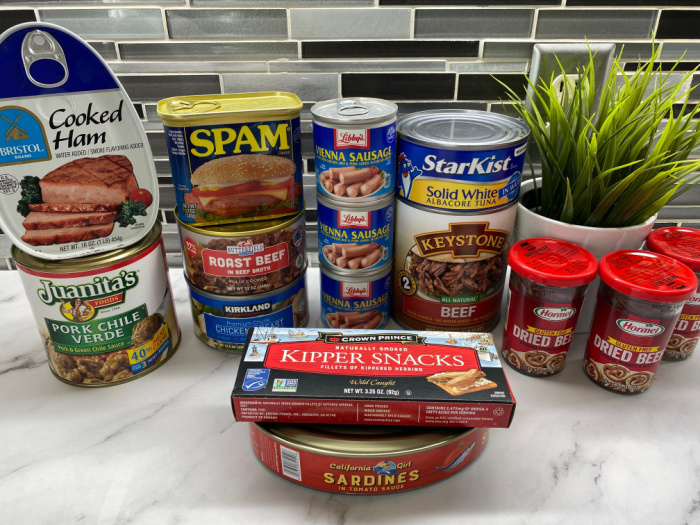
Canned chicken is one of the most versatile options available. It can be eaten cold directly from the can, mixed into soups, stirred into rice, or used as a base for simple stews. A single can typically provide 25 to 30 grams of protein and has a shelf life of three to five years. Stock multiple cases if your family regularly consumes chicken.
Canned tuna and salmon are equally important additions. These fish are rich in omega-3 fatty acids and high in protein, making them nutritionally dense emergency foods. Tuna packed in oil provides additional calories, which become important in high-stress or physically demanding survival situations. Salmon offers a slightly richer flavor and can be used in patties, salads, or eaten straight from the can. My loyal and knowledgeable reader, Harry, told me about this company where you can literally buy the best tuna in the world. Natural Catch Tuna
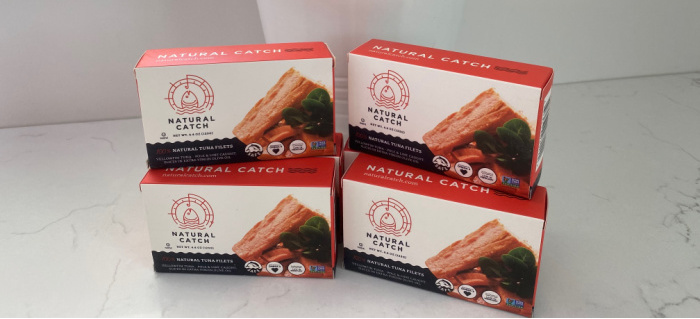
Canned beef, including products like corned beef and beef stew, provides a heartier meal option. These products are calorie-dense and satisfying, which matters when morale may already be strained. Spam and other canned pork products are similarly durable and widely available, and they pair easily with canned vegetables or rice to form complete meals.
Don’t overlook canned Vienna sausages or canned ham. While they may not be everyday favorites, they’re filling, long-lasting, and easy to prepare under difficult conditions. When building your supply, aim for a variety of protein sources so your family doesn’t experience food fatigue, which is a real morale concern in extended emergencies.
Canned Fruits: Nutrition, Hydration, and Morale
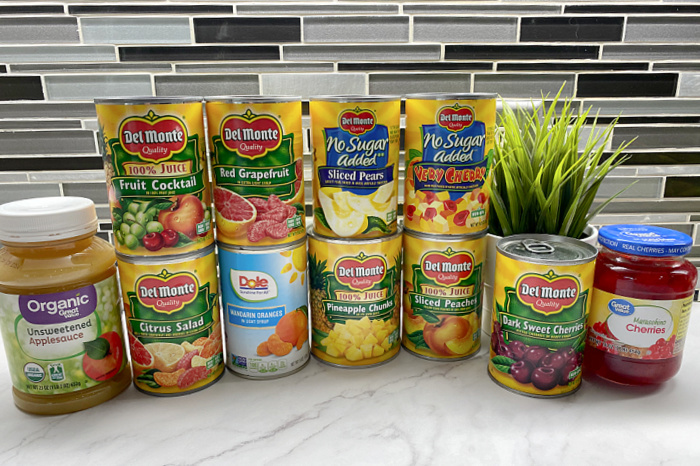
Canned fruits are often underestimated in emergency food planning, but they serve multiple critical roles. They provide natural sugars for quick energy, vitamins, and antioxidants that support immune health, as well as a liquid that helps with hydration when clean water may be limited.
Canned peaches, pears, and mandarin oranges are among the most popular options and tend to be well-accepted by children, which matters during stressful events when getting kids to eat can be a challenge. These fruits are packed naturally in juice or syrup, providing both nutrition and additional fluid intake. Look for options packed in 100% juice to reduce added sugar intake during already stressful conditions.
Canned pineapple is another excellent choice. It contains bromelain, an enzyme with anti-inflammatory properties, and its tart sweetness offers a refreshing contrast to the saltier canned meats in your pantry. Pineapple can also be used as a flavor enhancer when added to rice or meat dishes to help break up monotony.
Canned applesauce deserves a dedicated spot in any family preparedness plan, particularly for households with young children or older family members. It’s easy to digest, gentle on the stomach, and can serve as a snack, a side dish, or even a simple dessert. Many varieties are available with no added sugar, making them a cleaner nutritional option.
Canned tomatoes occupy a unique position because they function as both fruit and cooking ingredient. Diced tomatoes, crushed tomatoes, and tomato paste dramatically expand your cooking options, allowing you to prepare pasta sauces, soups, chilis, and stews from other shelf-stable pantry items. Tomatoes are rich in lycopene and vitamin C, adding meaningful nutritional value to your emergency meals.
Canned Vegetables: The Foundation of Long-Term Meal Planning
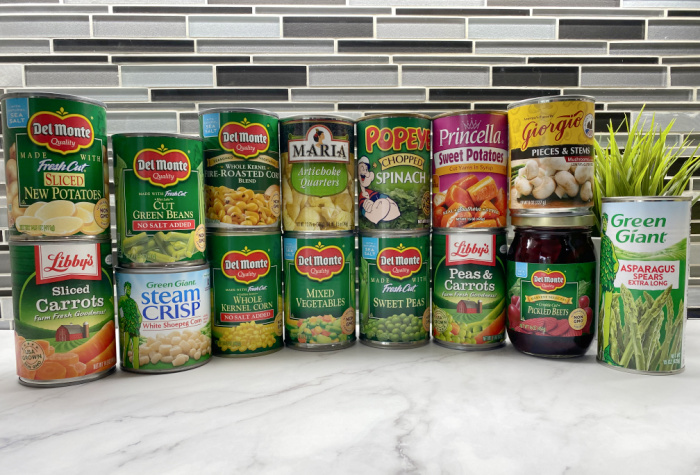
Vegetables round out your emergency nutrition plan by providing fiber, vitamins, and minerals that keep your family healthy over an extended period. Relying solely on proteins and grains without sufficient vegetables can lead to digestive issues and nutritional deficiencies within weeks.
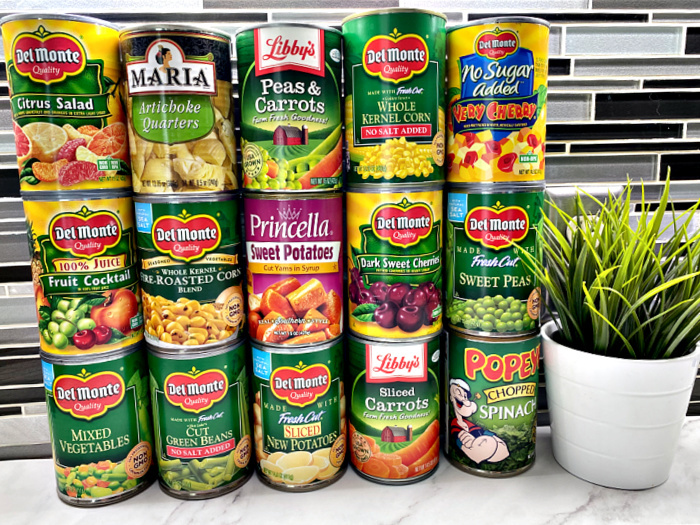
Canned green beans are a staple of emergency pantries for good reason. They’re low in calories, high in fiber, and have a mild flavor that goes well with nearly any other food. They can be eaten cold or heated quickly, and children tend to accept them without much resistance.
Canned corn is another highly versatile option. It adds sweetness, texture, and color to meals and combines naturally with canned beans and tomatoes to create filling, nutritious dishes. Corn is higher in carbohydrates than many other canned vegetables, making it a useful energy source when physical demands are high.
Canned Beans
Canned black beans, kidney beans, and chickpeas are among the most important items in any emergency food supply. Beans are calorie-dense, high in fiber, packed with plant-based protein, and extraordinarily affordable. A single can of black beans provides roughly 15 grams of protein and significant amounts of iron, magnesium, and folate. Beans also combine with canned meats and vegetables to create complete, satisfying meals with minimal preparation.
Canned spinach and canned mixed vegetables ensure that your family receives a broader range of micronutrients. Spinach is particularly rich in iron, calcium, and vitamins A and K. Mixed vegetable blends often include carrots, peas, green beans, and corn, providing nutritional variety without requiring you to stock every vegetable individually.
Don’t underestimate the value of canned potatoes. They’re calorie-dense and filling, and can be used in soups and stews or as a standalone side dish. For families with growing children or individuals who engage in physical labor, calorie density matters as much as nutritional balance during an emergency.
How Much Should You Store?
A general rule of preparedness is to calculate each family member’s daily caloric needs and multiply by the number of days you want to cover. The average adult requires approximately 2,000 calories per day, while active adults and teenagers may need closer to 2,500. Children’s needs vary by age and size.
A two-week supply for a family of four would require roughly 112,000 calories stored in shelf-stable form. That may sound like a large number, but canned goods are calorie-efficient and inexpensive. A thoughtful combination of canned meats, fruits, and vegetables, supplemented by dried rice, pasta, oats, and cooking oil, can achieve that target for a few hundred dollars spent over time.
Rotate your stock regularly by placing newer cans behind older ones and using the oldest items first in your everyday cooking. This practice, known as first-in, first-out rotation, ensures your supply stays fresh and nothing goes to waste.
Start Building Your Pantry Today
You don’t need a crisis to motivate you. The time to build a food reserve is before you need it. Begin with a one-week supply and expand gradually. Focus on foods your family already enjoys, since familiar flavors reduce stress during difficult circumstances.
War, natural disaster, economic collapse, or severe weather, any scenario that disrupts the food supply chain can put your family at risk. A well-stocked pantry built around canned meats, canned fruits, and canned vegetables is one of the most straightforward, cost-effective steps any family can take toward genuine self-reliance. Start today, buy a little extra each week, and build the security your family deserves.
Tip Of The Day
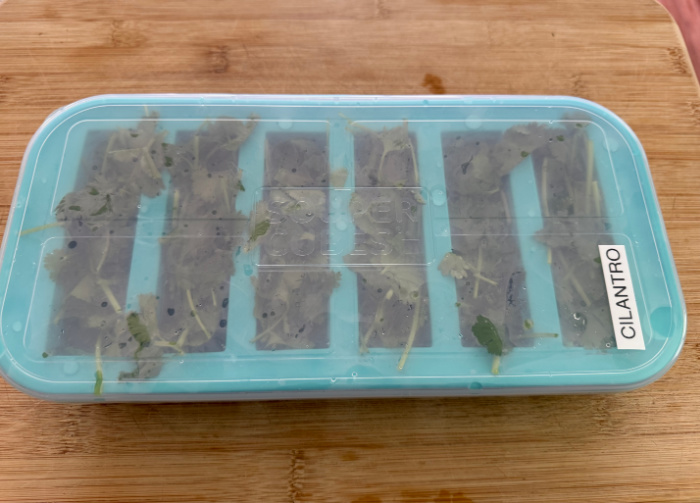
Did you know you can freeze cilantro in water and pop out a cube anytime you want some cilantro? 1/2 Cup Souper Cubes can be used to store the frozen cilantro for use later. I have a number of these and love them!
Cut The Cilantro
Cut the Cilantro to fit the “boxes”.
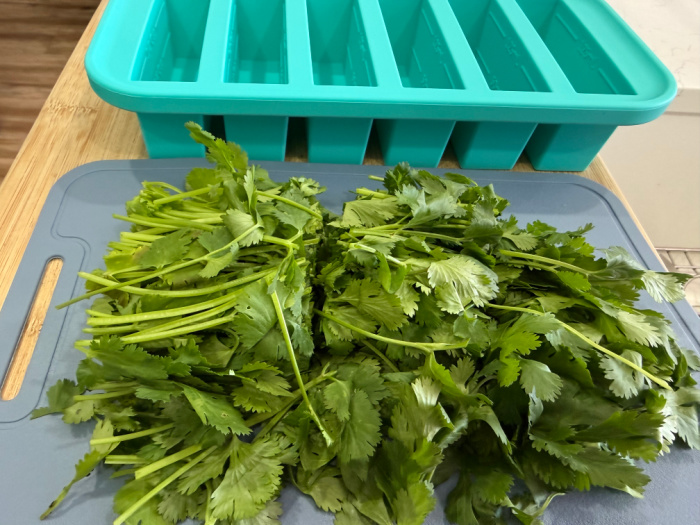
Wash The Cilantro
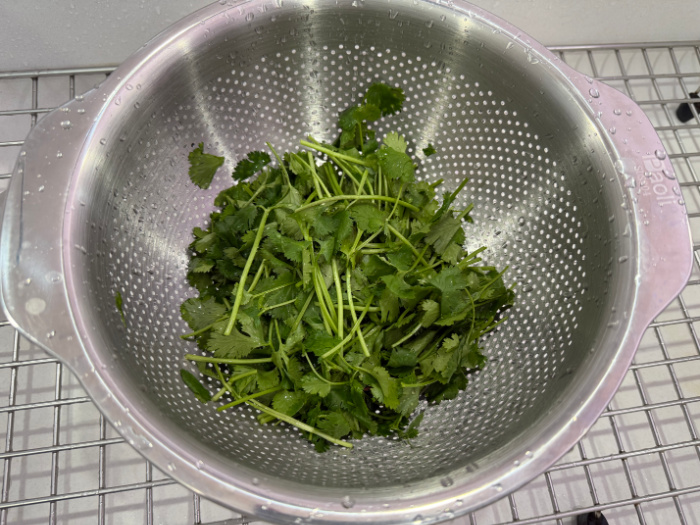
Wash and drain the Cilantro.
Fill The Trays With Cilantro
Place the Cilantro in the trays and partially fill with water. They need water to pop them out.
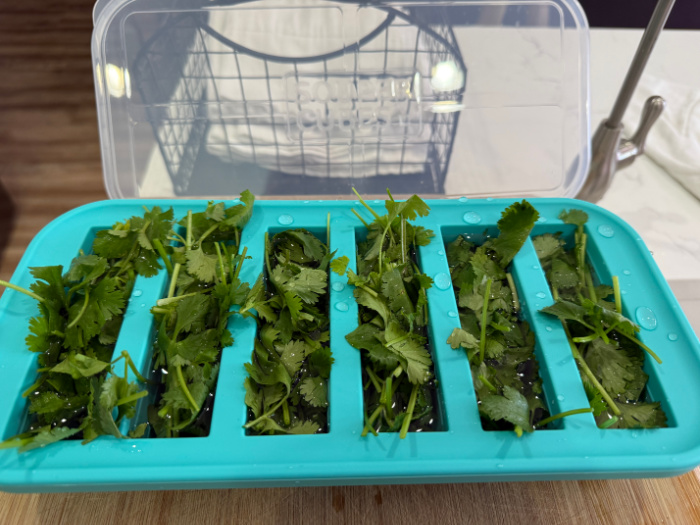
Fill The Trays With Water and Freeze Them
Pop out a cube when you need some Cilantro.
Final Word
No one wants to imagine a world where grocery store shelves are empty or the power grid has failed. But history has shown, time and again, that disruptions happen, and they happen fast. Within 72 hours of a major crisis, stores run out of essentials. Within a week, families without a plan begin to struggle.
The good news is that feeding your family through an extended emergency isn’t complicated. It doesn’t require a bunker, a large budget, or specialized skills. It requires a pantry stocked with the right canned goods, a little planning, and the willingness to act before a crisis forces your hand.
You can’t control whether a war breaks out, whether a hurricane knocks out your region’s infrastructure, or whether an economic shock empties store shelves overnight. What you can control is what sits in your pantry right now. Build it steadily, rotate it consistently, and rest easier knowing that, no matter what happens outside, the people in your home will be fed. That isn’t fear. That’s love in action. May God bless this world, Linda








In August, 1992 there was ONE disaster in the entire USA. Hurricane Andrew. I worked out in that Cat 5 storm. I was in charge of a field force of police officers. My group was 32 + me. There was another with us. We were all in a concrete bowling alley with a concrete ceiling. We fled out into the storm in our police cars at the peak of the storm when the ceiling began to collapse. The sky lights crackled. It was as if we were on the Poseiden adventure. At the time I opined to my counterpart, “Tom, I think we are going to flip over.” (I did not know about “how I am” until after being in my home during Ian and watching the water flow in under our home. Most homes had 5 1/2 FEET under them. The guy I used to crew for in Atlantic Ocean sailboat races told me after Ian that he knew I was ok because I don’t get scared or nervous/anxious. He has seen me angry- If things are not going well there is no time for “scared/nervous/anxious)
The point- I was drafted into THE command post in a condemned police station where we worked until after Christmas. we did not see ANY help from ANYWHERE for 2 weeks. Then, it was churches. Remember there were NO other diassters anywhere in the US.
Hurricane Charley 2004. Another Cat 5 here on the West coast of Florida. Again, the only disaster. It was more than a week for any help to come. I’ve been in 25+ hurricanes.
After Ian 3 years ago, our islands’ causeways were washed out. Only way on/off was by boat. It was a HUGE disaster. Several days to get any help, but it was sparce and mostly not useful. Most of us who stayed had what we needed.
We had NUMEROUS Chinook Helicopters coming out. Most of our homes were undamaged or damaged, but liveable. The Feds came out and told us POINT BLANK, that they brought NO SUPPLIES. They were ONLY there to take people off.
They expected us to vacate our homes so thieves could come in. The actual plan was to empty the islands and have the government take over and then let “certain people” get the land. One of the island is Sanibel. Ours was also a target.
We had enough supplies to take care of ourselves and EVERYONE who could carried a side arm or shotgun. “You loot, we shoot” signs were everywhere. In Florida our Sheriff and governor said they expected looters to be carrried out in bags.
What more documentation do people need than someone who was in the middle the way I was?
It’s worse now. FEMA is deeply broke and broken. You read about North Carolina? They came ready to help people fill out paperwork. NO help, but they had pens.
I have a number of expressions by which I live. I’ve said them all quite a few times.
Here is the best one for this application.
“Failure to plan on your part does not constitute an emergency on my part.”
If you are reading this blog/website and don’t prepare for what may/might/is coming, then, please refer to the above sentence. Survival of the fittest doesn’t mean you can run a mile!
This is life/death. If you don’t care about you and yours, there isn’t anybody who does.
Read and ACT upon what Linda suggests. She has it nailed.
Hi CAddison, oh my gosh, you always make me think, I LOVE it. “In August, 1992 there was ONE disaster in the entire USA”!!! ONE disaster in the USA and took weeks to get help to the people! I never really thought about it, but ONE disaster in the USA at the time. I need to get sign made with your statement: “Failure to plan on your part does not constitute an emergency on my part.”. BEST EVER COMMENT! Is it just me but I feel like there are more fires, flooding, tornadoes, and hurricanes than ever before. Plus, groups are trying to buy up the land that is damaged. Is this out of a movie or what? I think not. Linda
You are spot on. Look at Hawaii and Los Angeles. Scams galore.
And, the population is far less resiliant than ever. People in general are helpless. Debt levels mean 76% or so of Americans are right on the edge of financial/personal disaster 100% of the time. One little thing comes along and boom. Dave Ramsey does a really good job with his Total Money Makeover. But, like losing weight, everyone knows what to do, but few do it.
What we have coming in the financial situations of the entire world is astounding. It IS coming. I am confident you know that.
I have 2 stories that really resonate with people. They can personalize it.
My parents were kids when the Depression hit. They lived in different areas of the State and did not know each other. Dan’s family was desperately poor. The Dad was a party guy. 5 kids. My aunt told me that they would have starved were it not for the soup kitchens. AND, when the doctor said the malnourishment was so bad, they needed ORANGES. Like they could afford that. So Grandma went out into the tomato fields and gathered up the tomatoes that were not fit to sell. My aunt said she was so tired of tomatoes, but her mother literally saved her life.
I asked my aunt if they even knew the Depression hit? I mean they were already poor. She said, “Yes. The soup kitchens closed.”
Lesson: WHEN it hits again, there will be no food for the banks to give out. They depend on extras that will exist.
Mother’s family were pillars of their town. Living in the pre-Civil war victorian. 3 generations. My great grandmother, my grand parents, and my mom. Both grand parents had college educations. Rare in those days.
My grandfather came home that fateful black Friday (he always went home for lunch). This day was different. He asked his mother “Mama, how much money do you have?” She said, “I don’t know. Go get my purse. I’ll write you a check.” NO Mama, how much money do you have in your purse?
They looked. She had 38cents ($ 0.38). He said, “Mama, that’s all the money you have. The Banks closed.”
So, I say to all who read this…HOW MUCH MONEY DO YOU HAVE? All your investments and bank accounts are ELECTRONS. Poof. Gone. There is no difference from that time to this…food banks close and financial institutiions shut down. Private credit is already limiting the amount of money people can take out and it is THEIR money.
Try going to your bank and getting a significant amount of money. In an emergency situation, they will restrict what you can have.
My mom’s parents had skills. They were able to find work by heading to Detroit. Grandma even had housing for them. They did ok, but never got back where they were before.
Anyone can get a pantry going over time. BOGO is the best way.
It’s not paranoia if “they” really are after you.
Life is good.
Keep on trying. If you save ONE family, it changes the world.
Hi CAddison, I always love your thoughts, you have lived a life most have not. I have several readers than I know will survive, of course, you will. Most of my readers I have never met in person. Most will survive. When I write topics I try to help other be prepared. I don’t think everyone realizes how bad things are going to get. I hope I’m wrong. When we teach our kids skills and get them ready to launch on their own, we have done the best we could with the skills we have. Linda
I was just thinking about the definition of family. If it’s Tom and me then we’re good for 6-9 months, although water and milk will be an issue. But add 3 growing teen age boys and it comes down to 10 days!!! I am focusing on 6 adults and 3 boys, because our house would be safest until my son finishes building his new one. We have a whole house generator and we are gifting him one as a house warming gift. My son in law has us eating healthier so I’m sure he would bring alot with him. Maybe this would be a good discussion for the dinner table.
Hi Chris, the term family does make you think again, how many will I need to feed? In my case, there is just Mark and I, the rest are old enough to take care of themselves. They were raised to stock food, bake bread and cook from scratch. We had four daughters. They know they are on their own. They must stock what they need for their families. That may seem harsh, but I can’t afford to stock food and water for others in my little 1000 square foot home. I used to stock to feed the neighborhood with outdoor cooking stoves, and ovens. I have sold or given away the ones Mark and I will never use now at our age. I would have to rent a storage unit, I did that while we waited to build our home and it cost $10K, for four years. We thought it would be a year. Lesson learned. I would encourage every family to have a discussion over the dinner table as soon as possible. Linda
Linda,
Even those that are well off may find themselves in “need” of something. That happened to my wife and I when our son had to move home due to rent increases. The food we saved for one year will now last about three months. But we do have a large garden and the kids will be helping grow and preserve food this summer. You might have plans, but God laughs because he has different ones. We laugh when the unexpected happens.
Hi Larry, oh my gosh, the price of rent is outrageous everywhere! What a blessing you have a large garden. God does in fact have different ideas most of the time! We have to laugh knowing we will survive. Linda
CAddison gave us all some excellent examples of how quickly things can go south, and I believe it will happen. I am teaching a young mother in our neighborhood how to can. She already gardens and I’ve helped her freeze and do waterbath canning but she wants to learn how to use a pressure canner. I really believe skills will be more important than ever very soon.
Hi Paula, I totally agree with you. I can no longer pressure can or water bath food because my oxygen cannot be near a stove. It’s so frustrating. I’m happy to buy canned goods, they work for the two of us along with our freeze dried food. Skills will indeed be critical to know. Let’s hope people start to see it. Linda