
Let’s Talk Tornadoes: Where They Strike Most
This post may contain affiliate links. We may earn a commission if you purchase via our links. See the disclosure page for more info.

Let’s talk Tornadoes: Where They Strike Most. Tornadoes are among the most violent and unpredictable weather events on earth. Unlike hurricanes, which give days of advance notice, tornadoes can form and touch down within minutes. Every year across the United States, hundreds of families face the terrifying reality of a tornado bearing down on their home with little time to act. But here’s the truth that doesn’t get said often enough: the families who survive tornadic events are almost always the ones who prepared before the storm ever formed. This post gives you the full picture, region by region, month by month, and step by step.
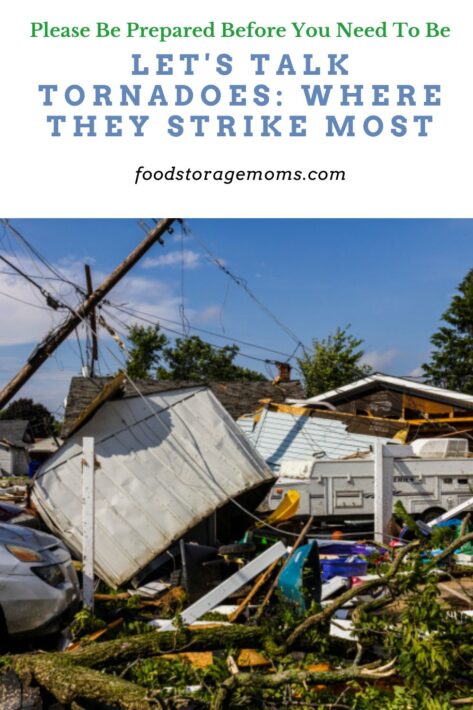
Let’s talk Tornadoes: Where They Strike Most
Section 1: Where Are Tornadoes Most Common?
The United States is the most tornado-prone country on earth, and by a significant margin. Geography is the primary reason. The vast, flat interior of the continent acts as a collision zone where three very different air masses meet: warm, humid air pushing north from the Gulf of Mexico, dry air sweeping east off the Rocky Mountains, and cold polar air descending from Canada. When these systems clash, the atmosphere becomes unstable in ways that produce supercell thunderstorms, the type of storm most likely to generate strong, long-track tornadoes.
But tornado risk isn’t confined to a single corridor. While the popular term “Tornado Alley” dominates public awareness, meteorologists and emergency managers increasingly recognize several distinct high-risk zones across the country, each with its own seasonal patterns, terrain, and hazards.
Tornado Alley
States: Texas, Oklahoma, Kansas, Nebraska, Colorado, South Dakota, Iowa
Tornado Alley is the name most people know, and it earned that reputation honestly. The flat, open terrain of the Southern and Central Plains allows supercell thunderstorms to travel for hundreds of miles without geographic interruption. Kansas and Oklahoma consistently rank among the most tornado-dense states per square mile in the country. Texas leads all states in raw tornado count due to its massive land area, recording well over 100 tornadoes in active years.
The defining characteristic of Tornado Alley storms is their visibility. Flat terrain and open skies mean that tornadoes are often visible from miles away, and warning lead times tend to be slightly longer than in regions with more complex terrain or tree cover. This doesn’t make them less deadly, but it does give families more time to act when they have a plan in place.
Peak activity in this region runs from late March through early July, with May being historically the single most active month. The town of Moore, Oklahoma, has been struck by violent tornadoes multiple times in the past three decades, making it one of the most repeatedly impacted communities in the world. This isn’t a coincidence. It sits in the geographic heart of the most active tornado zone on earth. NOAA Radio, Flashlights, Lanterns, Power Banks, and Power Outage Plug-in Lights.
Dixie Alley
States: Mississippi, Alabama, Tennessee, Arkansas, Louisiana, Georgia, South Carolina
Dixie Alley is, by many measures, more dangerous than its more famous counterpart. The Southeast consistently produces a disproportionate share of tornado fatalities relative to its tornado count, and there are several well-documented reasons for this. Headlamps
First, the terrain is complicated. Trees, hills, and ridgelines block sight lines, making it very difficult to see a tornado approaching until it’s already close. Second, the region has a much higher rate of nighttime tornadoes than the Plains states. A tornado warning at 2 a.m. when your family is asleep presents an entirely different challenge than one at 3 p.m. on a clear afternoon. Third, tornadoes in the Southeast tend to move faster and track farther, reducing the window for response. Alabama and Mississippi have experienced some of the deadliest tornado outbreaks in recorded U.S. history, including the April 2011 Super Outbreak, which produced over 219 tornadoes across the region in a single day.
Dixie Alley has two distinct peak periods: late February through April, and again in November. This second autumn season is often overlooked by families who assume tornado season ends in summer, and that assumption has cost lives.
IMPORTANT: Families in Dixie Alley face higher fatality rates than those in Tornado Alley, largely because of nighttime storms and terrain that hides approaching tornadoes. A weather radio with battery backup that wakes you from sleep isn’t optional in this region. It’s essential.
Hoosier Alley
States: Indiana, Ohio, Illinois, Missouri, Michigan
Hoosier Alley receives far less media attention than the other tornado zones, but the risk is real and significant. Indiana, Illinois, and Ohio consistently rank in the top fifteen states for tornado frequency, and the dense population of the Midwest means that a single tornado can affect far more people and structures than the same storm over open Kansas farmland.
The terrain here is a mix: gently rolling farmland in central Indiana and Illinois provides decent sight lines, but suburban sprawl and urban areas create complex warning and response challenges. High-rise apartments, dense neighborhoods, and mobile home parks all present unique vulnerabilities that rural residents don’t face.
Tornadoes in Hoosier Alley peak in spring (April through June) and show a secondary peak in late autumn. The tri-state tornado of 1925, which killed 695 people across Missouri, Illinois, and Indiana, remains the deadliest single tornado in U.S. history. It’s a sobering reminder that this region’s history with violent tornadoes is long and serious.
Florida
Zones: Peninsula, Panhandle, and coastal zones statewide
Florida presents a unique tornado profile that surprises most people. The state ranks consistently among the top five in total tornado count nationally, yet most of its tornadoes are relatively weak and short-lived. They form primarily from two sources: sea-breeze collisions along both coastlines during the summer thunderstorm season, and the outer rain bands of tropical storms and hurricanes that sweep inland.
The Florida Panhandle, which shares the Gulf Coast corridor with Alabama and Mississippi, behaves more like Dixie Alley and sees more significant springtime tornado activity. Central and South Florida see consistent, though typically weaker, tornado activity from June through October as summer storms fire daily across the hot, humid peninsula.
What makes Florida particularly interesting from a preparedness standpoint is the year-round risk. Unlike the Plains states, where a family can reasonably relax in December, Florida residents face meaningful tornado risk in every calendar month. The good news is that the high frequency of tropical weather means residents are generally more alert to severe weather, though complacency with weak, brief tornadoes remains a real problem.
NOTE: Tornadoes have been recorded in all 50 U.S. states. Even states like Massachusetts, Washington, Wyoming, and Alaska have tornado history. No family anywhere should consider tornado preparation irrelevant. Utah had a tornado last week in Northern Utah. Cache County is where the tornado hit, and they hadn’t had a tornado in 76 years, so this one was, I’m sure, a shock to those who live there. Only two other tornadoes have hit Rich County in Utah in 76 years; this marks the first in over 60 years. KSL News, I quote “A rare EF-1 tornado touched down in northern Utah last weekend. The brief tornado snapped trees, with 100-mph winds and a width of 100 yards.
Section 2: The Tornado Calendar — Month by Month
Tornado risk is intensely seasonal, but the calendar varies significantly by region. Understanding when your specific area is at peak risk is just as important as knowing that risk exists at all. The month-by-month breakdown below applies primarily to the central and southern United States, with regional notes for the Southeast and Florida.
Risk levels: April, May, June = HIGHEST RISK | March, July, August, November = MODERATE RISK | January, February, September, October, December = LOWER RISK
January and February — Lower Risk
Overall activity is low nationally, but the Southeast, particularly Mississippi and Alabama, can see dangerous tornado outbreaks during winter warm spells when Gulf moisture surges northward. Families in Dixie Alley should never fully lower their guard in winter. A significant outbreak struck the Southeast in February 2017, catching many families off guard precisely because it was mid-winter.
March — Moderate Risk
Tornado season begins in earnest across Texas and the Gulf Coast states in March. The Southern Plains begin to see increased supercell activity as the sun angle rises and Gulf moisture pushes northward. Families in Texas, Louisiana, Arkansas, and the Lower Mississippi Valley should be on alert by early March. The atmosphere isn’t at peak instability, but significant outbreaks have occurred.
April — Highest Risk
April is peak season for Dixie Alley and a major threat month for Tornado Alley. The combination of increasing solar heating, Gulf moisture, and frequent cold fronts from the north creates explosive severe weather setups. The April 2011 Super Outbreak, the largest tornado outbreak ever recorded, occurred in April. Families across the entire central and eastern U.S. should be at maximum readiness throughout April.
May — Highest Risk
May is historically the most active tornado month in the United States, driven primarily by intense supercell activity across Oklahoma, Kansas, Texas, and Nebraska. The atmospheric conditions are at their most volatile: maximum instability, strong wind shear, and frequent storm systems. Some of the most violent individual tornadoes in recorded history, including the 2013 EF5 that struck Moore, Oklahoma, occurred in May. Every family in Tornado Alley and Hoosier Alley should treat May as a month of active readiness.
June — Highest Risk
June shifts the primary activity zone northward into Nebraska, South Dakota, Iowa, and Minnesota, as the jet stream lifts. The Central and Northern Plains see peak activity, and tornado outbreaks remain frequent and potentially severe. June also begins the period when severe weather is more likely during evening and nighttime hours in the northern states, adding a layer of danger for sleeping families. The tornado season in the Southeast typically winds down, but hasn’t fully ended.
July and August — Moderate Risk
Activity decreases but doesn’t disappear. The jet stream retreats far to the north, reducing the classic supercell setup. However, Florida enters its most active period for tropical and sea-breeze tornadoes. The Central Plains can still see tornadoes during large severe weather events, and portions of the Upper Midwest remain in play. August also marks the beginning of the Atlantic hurricane season, which introduces tornado risk along the Gulf and East Coasts from tropical systems.
September and October — Lower Risk
Nationally, this is the quietest stretch of the year for tornadoes. But don’t fully disengage. Hurricane season peaks in September, and a landfalling tropical system can spawn dozens of tornadoes across the Carolinas, Georgia, Florida, and the Gulf Coast. October marks the beginning of the autumn secondary season in the Southeast, with activity picking up in the Tennessee Valley and Deep South by late month.
November — Moderate Risk
November is the often-forgotten danger month. The Southeast’s second tornado season peaks in November as the jet stream dips south again and Gulf moisture surges northward ahead of strong cold fronts. Alabama, Mississippi, Tennessee, and Arkansas are the primary risk areas. Critically, November tornadoes frequently occur after dark, when families are home but asleep or settled in for the evening. The December 10-11, 2021, outbreak, which began in late November and persisted into the early winter, caused catastrophic damage across Kentucky and neighboring states.
December — Lower Risk
Activity falls to its annual low nationally, but the Southeast remains a watch area during active weather pattern setups. Any month with a strong cold front sweeping across the Gulf, moisture can produce isolated severe weather. Treat December as low-risk but not no-risk, especially in the Deep South. “The families who survive are almost always the ones who had a plan before the storm ever formed.”
Section 3: What Your Family Needs to Prepare Right Now
Preparation isn’t a one-time purchase. It’s a set of decisions and practiced behaviors that become second nature before a storm is ever on the radar. The following section breaks down every meaningful step your family can take, organized from the most foundational to the more detailed.
Know Your Safe Room Inside and Out
The single most important tornado preparation a family can make is identifying and clearly communicating the location of the safe room to every household member, including children and frequent visitors. The safe room concept is simple: you want to be as low as possible, as interior as possible, and as far from glass as possible when a tornado strikes.
In homes with a basement, the basement is always the best option. Move to the most interior corner, away from windows. Protect your head with a light mattress, heavy blankets, or a bicycle helmet. Don’t stand near water heaters, furnaces, or other gas appliances. If you have a designated storm shelter installed in your basement floor, that’s even better.
In homes without a basement, choose an interior bathroom, closet, or hallway on the lowest floor. Bathrooms have the added advantage of plumbing-reinforced walls, which provide slightly more structural integrity. Get into the tub if available and cover yourself with a mattress or heavy blankets. Interior closets in the center of the house work well. Avoid any room with exterior walls or windows.
In mobile homes or manufactured housing, leave immediately and go to the nearest sturdy building or pre-identified community shelter. No mobile home, regardless of age or size, offers adequate protection from even a weak tornado. This is non-negotiable.
WARNING: Mobile homes are the single most dangerous place to be during a tornado. A tornado that would cause minor damage to a framed house can destroy a mobile home. If you live in a mobile home, identify your nearest shelter building today and make sure every family member knows to go there at the first sign of a warning.
Build Your Alert System
You can’t shelter from a tornado you don’t know is coming. Building a redundant alert system for your household is one of the highest-leverage preparations you can make. Redundancy matters because any single system can fail: cell service gets overwhelmed, power goes out, you’re in the shower and miss a notification. Layer multiple systems so that at least one always reaches you.
- Enable Wireless Emergency Alerts (WEA) on every smartphone in the household. These are the loud, jarring alerts that arrive automatically. Make sure they’re not silenced by Do Not Disturb settings, especially overnight.
- Purchase a NOAA Weather Radio All Hazards receiver with battery backup. Place it in your bedroom. These radios broadcast 24 hours a day and can be programmed to alert only for your specific county, reducing alert fatigue while ensuring you never miss a real warning.
- Download the National Weather Service or a reputable severe weather app (such as Weather Underground, RadarScope, or the American Red Cross Emergency app) and enable push notifications for tornado warnings in your area.
- Know whether your community has outdoor tornado sirens and, critically, understand that they are designed to alert people outdoors, not those indoors. You can’t rely on hearing a siren inside your home, especially when windows are closed, and there is background noise.
- Establish a household rule: when a tornado warning is issued for your county, everyone goes to the safe room immediately, without waiting to look outside or confirm visually. Tornadoes can be rain-wrapped and completely invisible. The warning is your cue to act.
Understand the Difference Between a Watch and a Warning
This is one of the most commonly confused elements of tornado preparedness, and the confusion can be dangerous. Headlamps
TORNADO WATCH: Conditions are favorable for tornado development. Be alert, monitor the weather, and know where your safe room is. You don’t need to shelter yet, but stay aware and be ready to act within seconds.
TORNADO WARNING: A tornado has been spotted on radar or by trained spotters. This is immediate action time. Go to your safe room now. Do not wait, don’t look outside, don’t grab belongings. Seconds matter.
The National Weather Service also issues Tornado Emergencies, which are reserved for particularly dangerous and life-threatening situations. These represent extreme, rare events where catastrophic damage and fatalities are considered likely. Treat a Tornado Emergency as the highest level of urgency.
Assemble Your Shelter Kit
Your safe room should have a pre-assembled kit that requires no last-minute gathering when a warning sounds. The goal is to have everything you need already in place so that when a warning is issued, you can go directly to the safe room without stopping anywhere else in the house.
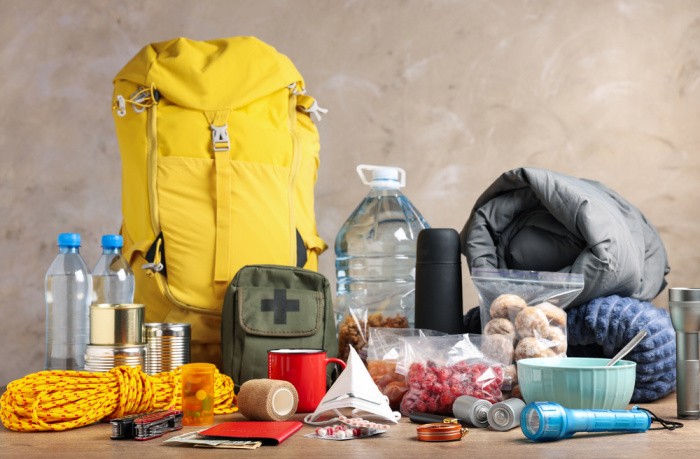
- Water: at least one gallon per person, stored in sealed containers. You’ll be sheltering for longer than the tornado itself, particularly if the area is severely damaged and rescue takes time. I prefer 4 gallons per person per day. You decide what you’re comfortable with.
- Flashlight or headlamp with fresh batteries. Power will likely be out. A headlamp is particularly useful because it keeps your hands free.
- Charged portable phone charger (power bank). Your phone is your lifeline after a tornado for communication, emergency services, and weather updates. Keep it charged.
- Sturdy shoes for every family member are stored in the shelter area. Post-tornado debris fields are full of glass, nails, and sharp metal. Bare feet or soft shoes are dangerous in the aftermath.
- Bicycle helmets or other hard-shell head protection for each family member, especially children. Head injuries from flying debris are a leading cause of tornado-related fatalities. Helmets significantly reduce this risk.
- Basic first aid kit. Include bandages, antiseptic wipes, gauze, medical tape, and any prescription medications that household members require daily.
- A blanket or sleeping bag. Tornadoes frequently occur at night, temperatures can drop rapidly after a storm system passes, and you may be sheltering for an extended period.
- Copies of important documents in a waterproof bag: insurance cards, identification, prescription information, and an out-of-area emergency contact card. Original documents should be stored in a fireproof, waterproof box elsewhere in the home.
- Snacks that don’t require preparation. Granola bars, nuts, or dried fruit are sufficient. This is less about caloric need and more about having something to give children to help them stay calm during extended sheltering.
- A small comfort item for young children: a stuffed animal, a small toy, or a familiar blanket. Children who have a comfort object feel more secure and calm, which helps everyone in the space stay focused.
Run a Family Drill
Drills aren’t just for schools. A family that has physically practiced its tornado response will act faster, more calmly, and more effectively when a real warning occurs. The chaos and fear of an actual tornado significantly impair cognitive function. Practiced muscle memory takes over where thinking struggles to keep up.
Run your first drill on a calm, sunny day and treat it as a low-key household exercise rather than a scary scenario. How long does it take your family to get from any room in the house to the safe room? Walk through the route with young children multiple times until they can do it independently. Do a night drill at least once annually so family members practice navigating to the safe room in the dark.
Include teenagers and older children as active participants rather than passive followers. Give them a specific role: one teen’s job might be to make sure the dog is with them, another’s might be to grab the shelter kit bag. When everyone has a clearly defined job, the drill runs more smoothly, and the real event will, too.
NOTE: A drill that takes 45 seconds in practice will likely take 15 seconds in a real event because the adrenaline of an actual warning accelerates movement. The goal of drilling isn’t speed. It’s clarity. When everyone knows exactly where to go and what to do, panic is replaced by purposeful movement.
Talking to Children About Tornadoes
Children who understand tornado safety are more likely to act appropriately and are less likely to panic in a real event. The key is to frame tornado preparedness as a routine, confident family activity rather than a frightening emergency scenario. Match the conversation to the child’s age and developmental stage.
For young children (ages 3 to 7): Keep it simple and concrete. “When the tornado alarm goes off, we go to the bathroom and get in the tub. It’s our safe hiding spot, like a game.” Let them help stock the shelter kit. Put their helmet in it themselves. Children who feel ownership over a preparation are more likely to remember and follow it.
For school-age children (ages 8 to 12): Explain the science at a basic level. Tornadoes form from certain kinds of storms. They move fast, and our safe room is the place where the house is strongest. Explain watches versus warnings. Practice checking a weather app with them. Make it feel like competence-building, not fear-stoking. You may not be at home when the tornado events happen, so they need to have some independent knowledge that will prompt the right action.
For teenagers: Involve them fully. Teach them how to read radar on the news and interpret a warning, and give them real responsibilities in the family plan. A teenager who understands the situation is an asset, not just a family member, to move to safety.
Preparing for the Aftermath
Preparedness doesn’t end when the tornado passes. The hours and days after a tornado can be just as dangerous as the event itself if families aren’t ready for the recovery phase.
- Don’t exit your shelter until the warning has expired and official all-clear information is available. Multiple tornadoes can follow in sequence during large outbreaks, and the lull between them can be mistaken for the end of the threat.
- If your home has structural damage, check for gas leaks before using any electrical switches or open flames. If you smell gas, leave the building immediately and don’t re-enter until a utility professional has cleared it.
- Wear your sturdy shoes before stepping outside the shelter. Post-tornado debris fields are extraordinarily hazardous, with nails, glass, splintered wood, and downed electrical lines common even in moderate-damage zones.
- Don’t approach or touch downed power lines. Assume every line is live and lethal until a utility crew confirms otherwise. Keep children well away from any downed wires.
- Have your homeowner’s or renter’s insurance information in your shelter kit so you can begin the claims process from your phone while still on scene, if necessary.
- Check on older or disabled neighbors who may need assistance getting out of damaged structures or accessing help. Community resilience in the immediate aftermath saves lives before emergency services can reach everyone.
Final Word
Tornadoes are dangerous, disorienting, and deeply frightening. But they’re not random in where they happen or when they happen, and preparation genuinely changes outcomes. Families who have identified their safe room, built their alert system, assembled their shelter kit, and practiced their plan survive at dramatically higher rates than those who haven’t. The investment is modest. The return is your family’s safety.
If you live in Tornado Alley, Dixie Alley, Hoosier Alley, or Florida, treat the first week of tornado season as a deadline by which your preparation must be complete. If you live anywhere else in the country, treat tornado preparedness as a baseline standard of household readiness, not a regional concern that belongs to someone else.
Start today. Pick one item from any of the checklists above and complete it before the end of the day. That is the first step, and it’s the most important one. May God bless this world, Linda
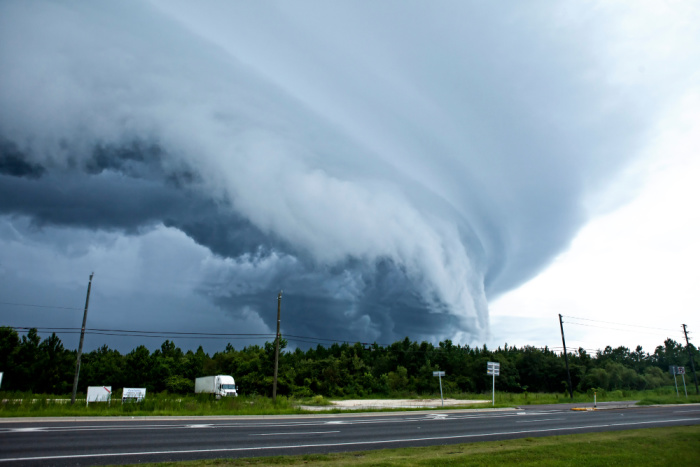
Copyright Images: Tornado Touching Down In Florida AdobeStock_102519765 By Wollwerth Imagery, Tornado EF3 Residential AdobeStock_495935202 By jetcityimage











We’ve had 38 in Oklahoma so far not counting last nights strikes on several places.
First week of May I move everything important into the shelter and leave it there. Things like extra medications we don’t need for the week, key rings for my trailers and spare vehicle keys.
Have a bag packed with tangibles such as guns, precious metals, extra cash and paperwork.
Should you lose your meds in one Walgreens and Walmart round here are very good at getting you replacements and helping out.
Some of the best ways to help tornado victims is to do laundry for them and to get snacks and water etc to responders who work long shifts.
Not FEMA though. They are a hindrance to clean up and full of empty promises.
Avoid being a lookielou post tornado strikes. Yup don’t need to see it and you are in the way
Hi Matt, great information, this helps everyone. I have heard bad things about FEMA, I love your idea about handing snacks and water to first responders. LOVE IT!! Then get out of the way and let them do their jobs. Great comment! Linda
I agree with Matt. We have a basement and keep it ready to go year-round, no matter the weather. I’ve survived 2 tornadoes in my life; as a toddler (which I don’t remember) and as an adult. Both of those tornadoes killed more than a dozen people. I’m not terrified of them, but have a deep respect. They can change life in an instant.
My heart goes out to the people of Enid, Oklahoma who are affected by last night’s tornado. I’ve heard preliminary reports it was an EF4, very powerful. I lived there as a young woman and that is a great community.
Hi Paula, I just looked up Enid, Oklahoma, it’s “Queen Wheat City”!! You grow wheat, oh my gosh!! It’s a famous city! I just watched your Governor talk about the 40 homes damaged and I think 10 hurt but no deaths as of right now. That city is very organized it sounds like they are up and running trying to get help for the community. You are so right things can change life in an instant. Linda
My husband was born & raised In Mayfield, Ky. The destruction essentially took out the entire downtown & 2 churches, who are still rebuilding. His home church, not destroyed, just completed a multimillion dollar repair. Our understanding from natl’ sources, KY is now included in 1 of those alleys. Took long enough! Wichita brother says KY has more than KS. # of tornadoes we have experienced is crazy dating back to 1974, not including a destruction in early 1900’s. Always prepared here and I’m the one who stays up all night to warn everyone.
Hi Marilynne, wow, the weather is crazy expanding to more and more states! It’s a great feeling to know you and your family are prepared. I can’t imagine seeing all that destruction downtown and 2 churches. Just the cleanup, the rebuilding is so overwhelming. Stay safe, my sweet friend! Linda
While we have never experienced a tornado, we have total respect for Mother Nature and the weather.
Hi Chris, heavy snow for sure! Linda
Linda, we’ve talked about tornadoes before. When I was a kid in SE KS my family lost two homes to them. We saw them every year, often more than once, but in daylight we could see them from a long way off.
We even had a small twister about 15 miles E of us here in Kingman, AZ, two years ago.
Being prepared like Matt and Paula are is the best way to go. But if you live in an area where the water table is too high for a basement or storm cellar, convert an interior room into a storm proof room in your home.
Mostly, just stay alert and have an NOAA Weather Radio on 24/7/365 as it will alert you to watches and warnings.
I obviously meant 24/7/365 in the comment above.
Hi Ray, I fixed it. Linda
Hi Ray, I didn’t know you lost two homes to tornadoes when you were a kid. Oh my goodness! Great tip on the NOAA radio and making one interior room storm proof. Crazy storms keeping getting worse. Linda